Archive for the ‘Human rights and justice’ Category
Pope Francis and religious cosmopolitarianism
 February 10th, 2015 |
  Author:
 By Richard Falk
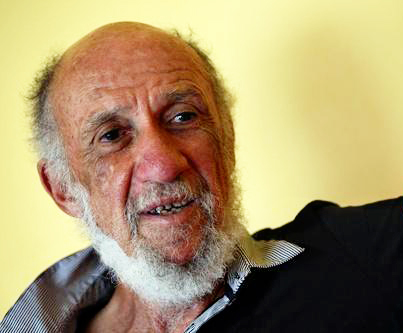
Richard Falk
January 10, 2015
Points of Departure
Perhaps, the most hopeful recent development in human affairs is the emergence of Pope Francis as the voice of global conscience. Although Francis speaks with papal authority to the 1.2 billion Catholics in the world, he also increasingly speaks with human authority to the rest of us. How significantly this voice will resonate might be viewed as the ultimate test as to whether ‘soft power’ is overcoming the geopolitical death dance that imperils the human species as never before.
When visiting occupied Palestine in May of 2014 Francis prayed at the notorious Israeli separation wall in Palestine that the World Court had ordered dismantled as unlawful back in 2004. The pontiff chose to pray near a scrawled graffiti that read ‘Pope, we need some 1 to speak about justice.’ While in the Holy Land Francis articulated what justice should mean in relation to the Palestinian reality: the pope called the existing situation ‘increasingly unacceptable,’ defied Israel by speaking of the ‘State of Palestine’ while touring the West Bank, and urged the establishment of a ‘sovereign homeland’ for the Palestinian people where there would be freedom of movement (so long denied).
By this visit and declaration, Pope Francis indirectly underscored the ethical insight of Nelson Mandela and Archbishop Desmond Tutu that after the collapse of apartheid in South Africa, the great symbolic moral challenge directed at the conscience of humanity is the empowerment and liberation of the Palestinian people. Such an affirmation also confirms Francis’ credentials as an independent world leader who will not defer to Washington’s craven submission to Israel’s continuous trampling upon Palestinian rights.
More broadly, Pope Francis has made it repeatedly clear that he is a critic of global inequality and of a capitalist world economic system that has produced ‘plunder of nature,’ a ‘frenetic rhythm of consumption,’ and worship of ‘the god of money.’ Above all, according to the German cardinal, Walter Kasper, this is a pope who “wants to lead faith and morality back to their original center” in authentic religious experience.
Such leadership is definitely taking a form that Read the rest of this entry »
TFF PressInfo # 306: Islam is not the problem. But keep your own house in order
By Jonathan Power
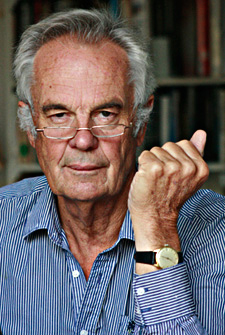
February 3rd 2015
The beheading of a Japanese journalist does not represent Islam. Saddam Hussein did not represent Islam. Bashar al-Assad does not represent Islam. Muammar Gaddafi of Libya did not represent Islam. The regular beheadings in Saudi Arabia for “crimes” such as adultery don’t represent Islam.
Likewise, the US dropping nuclear bombs on Hiroshima and Nagasaki didn’t represent Christianity. Nor did the torture practiced in Northern Ireland. Nor did the Buddhist-led atrocities against the Tamils of Sri Lanka represent Buddhism.
Nevertheless, it is probably true that in the late twentieth century a high percentage of the world’s violent conflicts took place inside the Muslim world or against non-Muslims. But that does not mean they were supported by a majority of Muslims. Indeed, I would surmise that they were approved by less than 1% of Muslims. Read the rest of this entry »
TFF PressInfo # 305: A theory of China
By Johan Galtung
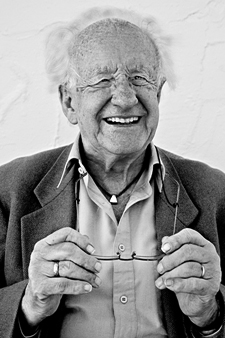
Johan Galtung
2 February 2015 at the Penang Institute, Penang
A theory serves comprehension, prediction and identification of conditions for change. Seven such historical-cultural pointers will be indicated for China; using the West in general, and the USA in particular, for comparisons. The presentation draws on countless dialogues in China over 40 years, since 1973.
* China: in time, as dynasties; West: in space as empires.
Look at a histomap combining world history and geography, time and space: China shows up through 4,000 years as relatively coherent dynasties with complex transitions – and the West as empires–birth-growth-peaking-decline-fall, like the Roman, UK and now US empires – duration vs bubbles that burst; as China-centric vs hegemonic. Read the rest of this entry »
Pope Francis, Salman Rusdie, and Charlie Hebdo
By Richard Falk
Richard Falk
Prefatory Note
This post is a much modified piece published a few days ago in AlJazeera English, and republished elsewhere on line. As many have now done it tries to enlarge the context in which the Charlie Hebdo events are understood beyond a highlight film clip in ‘the war on terror.’ The alleged link between the Chouachi brothers and Al Qaeda of the Arabian Peninsula (AQAP) allows the attack on Charlie Hebdo to be experienced as the French 9/11, and with this a return of France to a status of post-colonial geopolitical relevance.
Without grasping the relevance of how the dominant treat the dominated within our societies and throughout the world, we are consigning ourselves to many repetitions of the private and public horrors experienced in France on January 7, 2015.
There is some common ground, but not much. The killings in Paris last week were horrifying crimes that expose the vulnerability of democratic societies to lethal vigilante violence, whether facilitated from outside or as a spontaneous expression of homegrown psychopathic alienation. Beyond this naked, morbid reality associated with the murder of the Charlie Hebdo cartoonists, police officers, and the supermarket hostages there is nothing but darkness, and in that darkness some dangerous monsters lurk.
We can be again thankful for the moral clarity of Pope Francis who a few days ago in the impromptu setting of a plane taking him from Sri Lanka to Manila shined a light upon the darkness. Unlike those who so ardently wielded the slogan “Je suis Charlie” the Pope understood that free speech without limits is an invitation to indulge the worst negative impulses that will then operate as viruses destroying the vital organs of the body politic.
What Pope Francis underscored was the impossibility of reconciling dignity with hurtful insults, Read the rest of this entry »
 Posted in Culture & religion, Democracy - local & global, Discrimination, Ethics and values, Freedom of expression, Future perspectives, Global trends & events, Human rights and justice, Integration, International law, Islamophobia, Media perspectives, Pro-peace & proposals, Reconciliation & forgiveness, Richard Falk, Violence-prevention |
  No Comments »
The irrelevance of liberal Zionism
By Richard Falk
Richard Falk
January 4, 2015
Frustrated by Israeli settlement expansion, excessive violence, AIPAC maximalism, Netanyahu’s arrogance, Israel’s defiant disregard of international law, various Jewish responses claim to seek a middle ground. Israel is criticized by this loyal opposition, sometimes harshly, although so is the Palestinian Authority, Hamas, and activists around the world. Both sides are deemed responsible in equal measure for the failure to end the conflict.
With such a stance liberal Zionists seek to occupy the high moral ground without ceding political relevance. In contrast, those who believe as I do that Israel poses the main obstacle to achieving a sustainable peace are dismissed by liberal Zionists as either obstructive or unrealistic, and at worst, as anti-Israeli or even anti-Semitic.
Listen to the funding appeals of J Street or read such columnists in the NY Times as Roger Cohen and Thomas Friedman to grasp the approach of liberal Zionism.
These views are made to appear reasonable, and even just, by being set off against such maximalist support for Israel as associated with AIPAC and the U.S. Congress, or in the NY Times context by comparison with the more conservative views of David Brooks (whose son currently serves in the IDF) who published a recent ‘balanced’ column lionizing Netanyahu, “The Age of Bibi” [Jan. 2, 2014].
Of all the deformed reasoning contained in the column, perhaps the most scandalous was comparing Netanyahu to Churchill, Read the rest of this entry »
Misunderstood fundamentalism
By Jonathan Power
January 20th 2015
In his book “Faith and Power” Edward Mortimer, the former foreign affairs columnist for the Financial Times, when writing about Rishid Rida, the great Islamic intellectual of the first half of the twentieth century, asked himself if Rida was “fundamentalist” since he was an admirer of the militant Wahhabi puritans of Saudi Arabia. “I do not think so”, concluded Mortimer, “although I must admit that the precise meaning of this word when used in the context of Islam eludes me.”
At a time when the West is again aroused – because of the attack on Charlie Hebdo – by the actions of extreme Islamic fundamentalists we should note that it is astonishingly difficult to define fundamentalism either in Islam or Christianity. If it means “an effort to define the fundamentals of one’s religion and a refusal to budge from them once defined then surely anybody with serious religious beliefs of any sort must be fundamentalist in this sense”.
In Christianity there are many strains of fundamentalism. The Catholic Church, which abhors Enlightenment liberalism, is clearly fundamentalist when it comes to Read the rest of this entry »
“Je ne suis pas Charlie.”
By Chaiwat Satha-Anand*

The Paris march for unity on Sunday, January 11, 2015 attracted more than a million people and world leaders including Germany’s Merkel, Britain’s Cameron, Turkey’s Davutoglu, Israel’s Netanyahu, and Palestine’s Abbas, among others. This extraordinary action by leaders and citizens is in response to perhaps the bloodiest week in the last half of a century in France with 17 dead.
It began with the killing of 12 people at a previously little known satirical magazine “Charlie Hebdo.” French President Francois Hollande warned that the threats facing France is not over even after the three perpetrators were dead.
The threat is real, however, not only because of information gathered by various intelligence agencies, but also because the violence and what has followed indicates a rift in the way Europe, and in fact the world, is moving in the context of fierce contestation of different ethics/values people are willing to die and for some – to kill for.
This article is an attempt to argue that the motto “Je suis Charlie”, while commendable in terms of solidarity with victims of senseless violence, transform the killing into politics of identity with potentials for further deadly conflict in the present context if certain existing signs are properly understood.
Signs
Arguably in response to the killing in Paris, there are reports of Muslims becoming targets of more frequent attacks: women’s veils have been pulled at, pork thrown at mosques Read the rest of this entry »
Posted in Anti-semitism, Chaiwat Satha-Anand, Culture, Culture & religion, Democracy - local & global, Discrimination, Ethics and values, Freedom of expression, Human rights and justice, Islamophobia, Middle East, Migration and refugees, Nonviolence, Psychology - war & peace, Reconciliation & forgiveness, Violence-prevention |  Tags: Charlie Hebdo, freedom of expressioon, Paris January 2015, terrorism, terrorist |
No Comments »
Tags: Charlie Hebdo, freedom of expressioon, Paris January 2015, terrorism, terrorist |
No Comments »
Memoir sketch: Championing lost causes
By Richard Falk
Richard Falk
By chance I was reading César Vallejo’s poem, “Black Stone on a White Stone,” in a translation by Geoffrey Brock, and was struck by the opening stanza:
I’ll die in Paris in the pouring rain
a day I have a memory of already.
I’ll die in Paris—I won’t try to run—
a Thursday perhaps, in Autumn, like today.
Without being literal, I was reminded that I could appraise my death while alive, and not leave a final reckoning to some solemn memorial event in which speakers are challenged to find humorous anecdotes to lighten the occasion, otherwise uttering honorific platitudes quite unrelated to the experiential core of my being.
I had been thinking quite a bit recently about ‘lost causes.’
Recently I gave a lecture at Columbia University on this theme, inspired by Edward Said’s seminal late essay “On Lost Causes” (1997) in which he ties together the ‘nobility of failure’ as portrayed in literature with his own unswerving dedication to the Palestinian struggle for a just peace. On that occasion, Read the rest of this entry »
Posted in Abolition, Academia and science policies, Asia, Culture & religion, Ethics and values, Human rights and justice, International law, Israel/Palestine, Middle East, Nonviolence, Nuclear weapons, Poetry, Pro-peace & proposals, Psychology - war & peace, Reconciliation & forgiveness, Reflections, essays & more, Richard Falk, US Empire |
Tags: Edward Said, life commitment, Lost causes, memoires, memories, peace work, thnking about death, Vallejo, Vietnam War |
No Comments »
TFF PressInfo 301: Open Letter to Klaus Schwab of the World Economic Forum
By Kamran Mofid
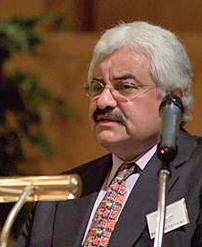
To:
Prof. Klaus Schwab,
Founder and Executive Chairman,
World Economic Forum
Switzerland
Dear Prof. Schwab,
I notice that you hope the 2015 WEF meeting will be a “starting point for a renaissance of global trust”. This is a noble aim, very important and timely. Thus, as the Founder of Globalisation for the Common Good Initiative (GCGI) I wish to endorse and support you in this aim.
Today in many parts of the world, the so-called market, and the values of consumerism, underpinned by the “Black Friday” values, have become increasingly dominant and are now seriously threatening our global future, both in terms of our care of the planet and in increasing societal rivarly and conflict.
In the process we have lost trust in everything. This is why I believe your aim is so important. In the global society in which we now all live, it is essential for our common survival and wellbeing that we build cultures of trust, being prepared to take risks for the common good.
Trust surely comes from the experience of a relationship – an in-depth experience – which by its nature is rooted in values that are not necessarily economic or monetary.
At the basis of such trust is an understanding that, in spite of our differences, we have our humanity in common. Archbishop Desmond Tutu speaks of ‘that African thing, Ubuntu’ – the notion that a person is only a person through other persons. A person with ‘Ubuntu’ is open and available to others; all others, for we are incomplete without each other. Ubuntu echoes the insight of John Donne, that ‘No man is an island ….. I am involved in mankind’, and that was in the seventeenth century, long before globalisation and the Davos Forum.
Having said that, I firmly believe that if you truly wish to bring about an environment of trust between the 99% who have never come to Davos and the top 1% that always do, then, it is important to sincerely ask why there exists such a high level of mistrust beween the two?
Continue reading Kamran Mofid’s argument and proposals to the World Economic Forum at the homepage of Globalisation for the Common Good Initiative (GCGI)
And read more about Dr. Kamram Mofid and the GCGI here.
Posted in Culture, Culture & religion, Democracy - local & global, Development, Ethics and values, Future perspectives, Global economics, Global trends & events, Human rights and justice, Kamran Mofid, Nonviolence, Pro-peace & proposals, TFF PressInfo, UN matters, Violence-prevention, World order/governance |
No Comments »
Could it be the world is getting better?
By Jonathan Power
January 13th 2015.
We have much to be glum about at the onset of 2015- the latest is the killings by ultra Islamists of the cartoonists in Paris. But we are brainwashed with bad news. “If it bleeds it leads”. One plane crash is worth more airtime than news that we are winning the fight against early death.
The World Health Organization has some telling facts. Over the last two decades infant deaths have fallen by a half. Measle deaths by three-quarters and both tuberculosis and maternal deaths by a half. AIDs-related illnesses have been cut by over a quarter. In 1960 one in five children died before the age of 5. Today it is one in 20, and falling.
Developing countries have caught up far more quickly in health than in wealth. For instance, Vietnam has the same health as the US had in 1980 but at present the same income per head as the US had in 1920.
Despite the Great Recession of the last six years poverty has plummeted. Although most of that drop has happened in China and India it has also happened in most Third World countries.
Population growth is slowing. Read the rest of this entry »