Archive for the ‘Human rights and justice’ Category
U.S. shares responsibility for Rachel Corrie’s death
 September 1st, 2012 |
  Author:
 By Stephen Zunes
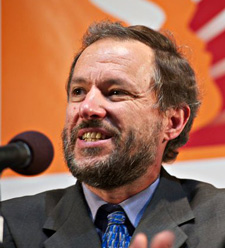
On August 28, an Israeli court rejected a civil lawsuit against Israeli occupation forces for the 2003 murder of Rachel Corrie, a 23-year old American peace activist killed in the Gaza Strip, upholding a severely flawed internal Israeli military investigation.
Amnesty International strongly condemned the decision, noting how “the verdict continues the pattern of impunity for Israeli military violations against civilians and human rights defenders in the Occupied Palestinian Territories (OPT). The verdict shields Israeli military personnel from accountability and ignores deep flaws in the Israeli military’s internal investigation of Corrie’s death.” Read the rest of this entry »
California State Assembly seeks to stifle debate on Israel
By Stephen Zunes
A new resolution casts such a wide net over anti-Semitism that it includes legitimate opposition to Israeli policies.
The California State Assembly has just passed a bipartisan resolution (HR 35) by voice vote which constitutes a serious attack on academic freedom and the rights of students and faculty to raise awareness about human rights abuses by U.S.-backed governments. While purporting to put the legislature on record in opposition of anti-Semitism on state university campuses, it defines anti-Semitism so widely as to include legitimate political activities in opposition to Israeli government policies. Read the rest of this entry »
Guatemala’s murderous past and this month’s belated justice
By Jonathan Power
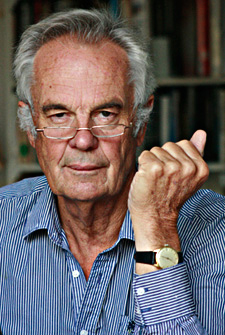
Guatemala’s claim to fame, apart from the ruins of the highly sophisticated Mayan civilization which present generations had nothing to do with, is that it is the country with the worst human rights record in the twentieth century among all the countries in the western hemisphere.
I recall once going to interview the then secretary-general of Amnesty International, Thomas Hammarberg, and asking him the country I should visit that had the worst human rights record in the world. He said “Guatemala”. I then asked how many political prisoners did it have. (Amnesty has a well tried and successful system of adopting political prisoners and then showering the authorities with demands they be released.) He replied “There are no political prisoners only political killings”. Read the rest of this entry »
 Posted in Human rights and justice, Jonathan Power, South America, Terrorism, US Empire |
  No Comments »
The Palestinian hunger strikes: Why still invisible?
By Richard Falk
– Month after month professor Richard Falk who is also the UN Secretary-General’s Rapporteur for the Occupied Territories, urges you to be aware of this rampant but invisible human rights violation by Israeli authorities. Please speak up, share with your friends and alert your media and politicians wherever you are.
Zionist lobbies throw around accusations of ‘anti-semitism’ which could be seen as a psycho-political projection of what might be appropriately be termed ‘anti-Palestinianism’, says blog editor Jan Oberg
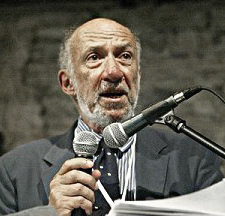
When it is realized that Mahatma Gandhi shook the British Empire with a series of hunger strikes, none lasting more than 21 days, it is shameful that Palestinian hunger strikers ever since last December continue to exhibit their extreme courage by refusing food for periods ranging between 40 and over 90 days, and yet these exploits are unreported by the media and generally ignored by relevant international institutions.
The latest Palestinians who have aroused emergency concerns among Palestinians, because their hunger strikes have brought them to death’s door, are Hassan Safadi and Samer Al-Barq. Both had ended long earlier strikes because they were promised releases under an Egyptian brokered deal that was announced on May 14, 2012, and not consistently implemented by Israel.
Three respected human rights organizations that have a long and honorable record of investigating Israeli prison conditions have issued a statement in the last several days expressing their ‘grave concern’ about the medical condition of these two men and their ‘utmost outrage’ at the treatment that they have been receiving from the Israeli Prison Service.
For instance, Hassan Safadi, now on the 59th day of a second hunger strike, having previously ended a 71 day fast after the release agreement was signed, is reported by Addameer and Physicians for Human Rights-Israel, to be suffering from kidney problems, extreme weakness, severe weight loss, headaches, dizziness, and has difficulty standing. It is well established in medical circles that there exists a serious and risk of cardio-vascular failure for a hunger strike that lasts beyond 45 days. Read the rest of this entry »
Hunting down the war criminals
By Jonathan Power
There can be no question that if President Bashar al-Assad of Syria falls the International Criminal Court will want to put him on trial for war crimes. The long arm of international law will reach him wherever he flees to. The ICC has an unblemished record in bringing to The Hague, the Court’s headquarters, the people they want. As the great heavyweight boxer, Joe Louis, once said, “You can run but you can’t hide”.
This week a new term begins for the justices. Read the rest of this entry »
Soul searching and common sense after Oak Creek
By Richard Falk
President Obama has responded to the killing of six members of the Gurdwara in Oak Creek, Wisconsin this last Sunday with these words:
“All of us recognize that these kinds of terrible, tragic events are happening with too much regularity. It is time for soul searching and we need to think of ways to reduce violence.”
What is most noticeable here, as it was in Obama’s tepid message of consolation to the families of the victims of the Auror a movie theater shooting of two week ago, is this reality: party politics trumps moral principle and even common sense in the aftermath of these extreme challenges to civic peace in America.
To fail to mention the grotesque absurdity of legally allowing almost everyone in the United States to buy assault weapons and large quantities of ammunition online or at neighborhood shops can only be explained by the intimidating influence of the gun lobby, and its accompanying gun culture, in this country as currently heightened by an ongoing, nasty presidential election campaign. Read the rest of this entry »
Beyond words: Poet’s lament
By Richard Falk
Poetry at its finest stretches the expressiveness of language beyond its prior limits, not necessarily by its choice of words, but through the magical invocation of feelings embedded deeply within consciousness. Yes even poetry has its own frontiers that if crossed lead to a word-less terrain littered with corpses of atrocity, what Thomas Merton and James Douglass have soulfully identified for us as the realm of ‘the unspeakable,’ and then are brave enough to explore forbidden terrain.
When we do not respect the unspeakable by our silence we domesticate the criminality of the horror that human beings are capable of inflicting on one another, and give way to the eventual emergence of normalcy as has happened with nuclear weapons detached from the happenings of Hiroshima and Nagasaki. Read the rest of this entry »
The politics of the economic crisis – class warfare
By Johan Galtung
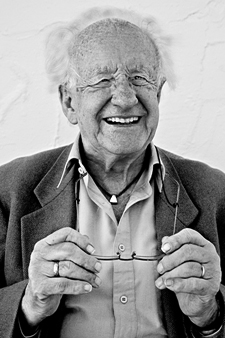
From Jondal, Norway
Writes Eduardo Porter on The New York Times:
“Perhaps the most surprising aspect of the Libor scandal is how familiar it seems. Sure, for some of the world’s leading banks to try to manipulate one of the most important interest rates in contemporary finance is clearly egregious. But is that worse than packaging billions of dollars worth of dubious mortgages into a bond and having it stamped with a Triple-A rating to sell to some dupe down the road while betting against it? Or how about forging documents on an industrial scale to foreclose fraudulently on countless homeowners?”
A useful summary of the situation as of today. But, a summary of what? What is this?
We have been through many answers starting with credit squeeze, then a real estate bubble that burst, toxic assets, credit swaps, hedge funds, derivatives – bets with the money of other people, yours and mine – all finance and banking. A psychologism was added at an early stage; greed. Read the rest of this entry »
For what?
By Richard Falk
Being disinclined to look in mirrors, not only to avoid evidences of aging, but also because of an autobiographical deficit, I have recently started to question the vectors of my motivation. Not to raise doubts but to seek some understanding of ‘for what?’ I am especially wondering the reasons behind my solidarity with the struggles of distant strangers, why such solidarity is not more widely shared with likeminded friends, and why the inevitable priorities as to what is emphasized and what is ignored have the shape they do.
Most pointedly, why am I giving the Palestinians so much more attention and psychic energy than the Kurds, Tibetans, or Kashmiris, and a host of other worthy causes? And how do I explain to myself a preoccupation with the unlawful, immoral, and imprudent foreign policy of the U.S. Government, the sovereign state of my residence upon whose governmental resources I depend upon for security and a range of rights? Read the rest of this entry »
Pros and Cons of solidarity with the Palestinian people
By Richard Falk
The posture of solidarity with the struggle of ‘the other’ is more complex than it might appear at first glance. It seems a simple act to join with others in opposing severe injustice and cruelty, especially when its reality is experienced and witnessed first-hand as I have for several decades in relation to the Palestinian struggle.
I was initially led to understand the Palestinian (counter-) narrative by friends while still a law student in the late 1950s. But my engagement was more in the spirit of resisting what Noam Chomsky would later teach us to call ‘indoctrination in a liberal society,’ a matter of understanding how the supposedly objective media messes with our mind in key areas of policy sensitivity, and none has turned out in the West, especially in North America, to be more menacingly stage managed than the presentation of Palestinians and their struggle, which merge with sinister forms of racial and religious profiling under the labels of ‘the Arab mind’ and ‘Muslim extremism.’ Read the rest of this entry »