Archive for the ‘Nuclear weapons’ Category
Japan and the world community
 April 14th, 2014 |
  Author:
 By Johan Galtung

From Osaka, Kyoto
Japan could have been a leading world power today.
Not a 19th century colonial-imperial-military power, but a peace power like Switzerland, only much bigger. If its political leaders had embraced the peace constitution with Article 9 – finally nominated for the Nobel Peace Prize – depriving Japan of the right to war with the same enthusiasm of its population. A recent public opinion poll showed 2/3, 63%-64% opposing collective defense as well as revision of A9.
It is not that A9 – which is against war, not for peace – is perfect. Betrayed by politicians “interpreting” and used as a comfortable sleeping pillow by the peace movement people, two solid pillars should have been added, like defensive defense and positive peace. Read the rest of this entry »
The New World Order?
By Richard Falk
There is no more reliable guardian of entrenched conventional wisdom than The Economist. And so when its cover proclaims ‘the new world order,’ and removes any ambiguity from its intentions, by its portrayal of Putin as a shirtless tank commander with menacing features.
No such iconography accompanied the last notable invocation of the phrase ‘new world order’ by George H. W. Bush in mobilizing support for a forcible response to the Iraqi invasion and annexation of Kuwait in 1990, the dirty work of Saddam Hussein. Read the rest of this entry »
 Posted in Abolition, Afghanistan, Democracy - local & global, Disarmament, Ex-Yugoslavia/Balkans, Future perspectives, International law, Iran, Iraq, Kosovo/a, Libya, Media & conflict, Media perspectives, Middle East, Nuclear weapons, Richard Falk, Russia, Sanctions, Security and defence, UN matters, US Empire, US politics & security, USA, Violence-prevention, World order/governance |
  No Comments »
The obsolescence of ideology: Debating Syria and Ukraine
By Richard Falk
I have been struck by the unhelpfulness of ideology to my own efforts to think through the complexities of recommended or preferred policy in relation to Syria, and more recently, the Ukraine. There is no obvious posture to be struck by referencing a ‘left’ or ‘right’ identity. A convincing policy proposal depends on sensitivity to context and the particulars of the conflict.
To insist that the left/right distinction obscures more than it reveals is not the end of the story. To contend that ideology is unhelpful as a guide for action is not the same as saying that it is irrelevant to the public debate. In the American context, to be on the left generally implies an anti-interventionist stance, while being on the right is usually associated with being pro-interventionist. Yet, these first approximations can be misleading, even ideologically. Liberals, who are deliberately and consigned to the left by the mainstream media, often favor intervention if the rationale for military force is primarily humanitarian.
Likewise, the neocon right is often opposed to intervention if it is not persuasively justified on the basis of strategic interests, which could include promoting ideological affinities. The neocon leitmotif is global leadership via military strength, force projection, friends and enemies, and the assertion and enforcement of red lines. When Obama failed to bomb Syria in 2013 after earlier declaring that the use of chemical weapons by the Assad regime was for him a red line this supposedly undermined the credibility of American power.
My point is that ideology remains a helpful predictor of how people line up with respect to controversial uses of force, although relying on ideology is a lazy way to think if the purpose is to decide on the best course of action to take, which requires a sensitivity to the concrete realities of a particular situation. Such an analysis depends on context, and may include acknowledging the difficulties of intervention, and the moral unacceptability of nonintervention. Read the rest of this entry »
Posted in Conflict and war, Ethics and values, Ex Yugoslavia, Ex-Yugoslavia/Balkans, Global trends & events, Human rights and justice, International law, Iran, Iraq, Israel/Palestine, Kosovo/a, Nuclear weapons, Political, Richard Falk, Russia, Sanctions, Security and defence, Syria, Ukraine, UN matters, US Empire, US politics & security, USA, Violence-prevention, World order/governance |
No Comments »
TFF PressInfo: The manufactured story about Iran’s nuclear program
By Farhang Jahanpour

As Iran and the world powers resume nuclear talks in Vienna with the hope of reaching a comprehensive agreement over Iran’s nuclear program by mid-July, the Israelis and their lobbyists in Washington are intensifying their efforts to scuttle the talks. In addition to all the efforts in the US Congress to impose additional sanctions on Iran, thus bringing the talks to a premature end, there are indications that Israel and her friends are continuing with various acts of sabotage against Iranian nuclear facilities.
In 2010, the so-called Stuxnet virus temporarily disrupted the operation of thousands of Iranian centrifuges. At least five Iranian nuclear scientists have been assassinated. Iran has also said that it has discovered tiny timed explosives planted on centrifuges but has disabled them before they could go off. On Monday 17 March 2014, Iran said that an alleged attempt to sabotage one of its nuclear facilities had involved foreign intelligence agencies that had tampered with imported pumps. However, in addition to all those acts of sabotage, there seems to be an intensive effort to manufacture a crisis by means of false intelligence.
Prior to the devastating Iraq war that destroyed the country and killed upwards of half a million people, not to say anything of thousands of Coalition forces who were killed and the two trillion dollars that was spent, a number of neocons bent on the invasion of Iraq manufactured various false reports in order to mislead the public and pave the way for the war.
On September 8, 2002, Michael R. Gordon and Judith Miller published a story in the New York Times that openly alleged that Saddam Hussein had intensified his quest for a nuclear bomb. They wrote: “In the last 14 months, Iraq has sought to buy thousands of specially designed aluminum tubes, which American officials believe were intended as components of centrifuges to enrich uranium… Bush administration officials say the quest for thousands of high-strength aluminum tubes is one of several signs that Mr. Hussein is seeking to revamp and accelerate Iraq’s nuclear weapons program.”
The unsuspecting public was misled by that false intelligence and the result was one of the longest and most disastrous wars in US history.
How the manufactured crisis was manufactured
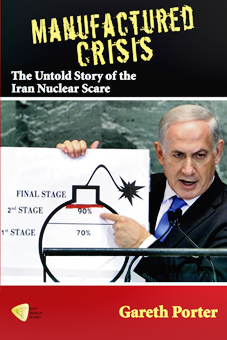
In his latest groundbreaking book, entitled A Manufactured Crisis: The Untold Story of Iran Nuclear Scare, the historian and investigative journalist Gareth Porter catalogs a long list of false reports manufactured by Israeli intelligence agencies in order to mislead the public and pave the way for a war against Iran. (1)
Posted in Abolition, Democracy - local & global, Egypt, European Union, Farhang Jahanpour, General issues, Human rights and justice, International law, Iran, Iraq, Israel/Palestine, Middle East, Military - technology, Negotiations, New books, Nuclear weapons, Security and defence, Syria, TFF PressInfo, Uncategorized, US Empire, US politics & security, USA |  Tags: A Manufactured Crisis, antiwar.com, Bandar Abbas, BBC, BND, deal with Iran, Dodgy Dossier, Douglas Feith, Gaza, German intelligence, Hassan Rouhani, IAEA, Iran's nuclear program, Jim Lobe, Judith Miller, Karsten Voigt, Katrine A, Lobe Blog, Mohammad Javad Zarif, Mojahedin-e Khalq, Paul Wolfowitz, Peter Jenkins, Port Sudan, ship to gaza, Sinai, Stuxnet, The Real News, U.N. Security Council, Yasser Arafat |
No Comments »
Tags: A Manufactured Crisis, antiwar.com, Bandar Abbas, BBC, BND, deal with Iran, Dodgy Dossier, Douglas Feith, Gaza, German intelligence, Hassan Rouhani, IAEA, Iran's nuclear program, Jim Lobe, Judith Miller, Karsten Voigt, Katrine A, Lobe Blog, Mohammad Javad Zarif, Mojahedin-e Khalq, Paul Wolfowitz, Peter Jenkins, Port Sudan, ship to gaza, Sinai, Stuxnet, The Real News, U.N. Security Council, Yasser Arafat |
No Comments »
Iran nuclear negotiations almost in the bag
By Jonathan Power
It was the Americans, back in the time of the deposed Shah, who encouraged Iran to develop a nuclear bomb-making capacity. Now it is the Americans, along with the Europeans, who are desperately trying to undo their folly.
They are nearer the goal than they think- or, rather, let on. Perhaps they are playing their cards too close to their chest? Is this what is necessary for the Administration to position itself to assuage Congressional opinion?
As long as both Iran and the US make sure, as the saying goes, they don’t “miss an opportunity to miss an opportunity” they should get home and dry well before the end of the six months allowed to complete final negotiations.
A word on the Iranian side: The Supreme Leader, Ayotallah Ali Khameini, who is ultimately the deciding figure, has long ago made his position clear. He has said on more than one occasion, indeed has issued a fatwa to this effect, that to possess nuclear weapons goes against God. Iran is a highly religious nation and these words of his cannot be taken lightly. He cannot put them on one side, even if the Americans prove difficult. Moreover, we have the statements of US intelligence of 2007 and repeated twice since that Iran has abandoned its nuclear weapons program.
If all this be true why don’t the delegates go home and put their feet up? Read the rest of this entry »
Pakistan – What Now?
By Johan Galtung
Islamabad, Ministry of Foreign Affairs, 28 Feb 2014
Your Excellencies,
The basic point is that Pakistan will not get that commodity called “peace” in Kashmir, Afghanistan and Central Asia by pursuing the ends and means of Washington and some local elites only. For peace to blossom the goals of other parties also have to be considered; and they are many. The logic of the political games pursued today presupposes some kind of victory or domination of “our side”: neither feasible nor desirable for peace. Hence, the need for some visions for peace politics is Kashmir, Afghanistan and Central Asia for tomorrow or the day after, with the hope that they can be useful when you have come to the end of the road with current policies. Nothing of this is easy; and without visions even impossible.
The fairly detailed, non-dogmatic vision appended (below) was my acceptance speech of the 2011 Abdul Ghaffar Khan International Peace-Builder Award by the Pakistan-American Muslim Association.
However, why do present policies so often seem to be non-starters?
The British empire drew three lines with disastrous effects for Pakistan: the Durand line in 1893, a 1,600-mile wound defining the border with Afghanistan, dividing the Pashtun nation – the biggest nation in the world without a state – into two parts; the McMahon line of 1914 defining the border with China in ways unacceptable to the Chinese; and the Mountbatten line of 1947 leading to the catastrophic violence of the partition. These lines have to be negated, liberating Pakistan from that past. Read the rest of this entry »
Posted in Abolition, Afghanistan, Asia, Conflict and war, Democracy - local & global, Development, Disarmament, Human rights and justice, India, India-Pakistan, International law, Johan Galtung, Nonviolence, Nuclear weapons, Pro-peace & proposals, US Empire, Violence-prevention, World order/governance |
No Comments »
60 years of nuclear pain – and not a word in the media
By David Krieger

As the trustee of the United Nations Trust Territory of the Pacific Islands, the United States had an obligation to protect the health and welfare of the Marshallese Islanders. Instead, the U.S. conducted 67 nuclear tests in the Marshall Islands between 1946 and 1958. These 67 nuclear tests had an explosive power equivalent to 1.6 Hiroshima bombs daily for 12 years. In short, the U.S. used these islands shamefully, and the Marshallese people continue to suffer today as a result.
Criminalizing aggressive war
By Johan Galtung
Kuala Lumpur, February 24, 2014
Few, if anybody, today argue this so forcefully as Mahathir Mohammad, Malaysia’s fourth prime minister, for 22 years. He compares what we do when one person kills another to all we do not do when millions kill millions in aggressive wars. We have clear laws, we apprehend the suspect, weigh the evidence for or against in court, and, if found guilty, the murderer is punished. There may even be a system of compensation for the bereaved.
But in wars among states the murderers get medals and honors, and if victorious relish a post-glory exuberance disorder, nourishing a new aggression. And the bereaved are left with their grief and a post trauma stress disorder, nourishing the idea of revenge. Madness, irrationality, a social evil of top rank, to be abolished. As Mahathir says: “Peace for us simply means the absence of war. We must never be deflected from this simple objective”. An important reminder for all who broaden the concepts of violence and peace: remember the essence!
One approach is criminalization. For that clear laws are needed, meaning without loopholes. The UN Charter is an effort (Articles 1.1 and 2.4) prohibiting war and the threat of war among (member) states. Read the rest of this entry »
Terrorists with nuclear weapons?
By Jonathan Power
US aviation authorities banned the carrying of toothpaste on planes heading to the Sochi Winter Olympics for fear they might contain a deadly explosive. Apparently such is the creativity of the modern terrorist.
Other departments of the US government rather more seriously worry about the transfer of nuclear materials to a terrorist group fit for an improvised “dirty bomb” (where explosives are wrapped with radiological materials) capable of bringing panic to a city, although it would only destroy not more than a block. Some go further and fear a small nuclear bomb could be smuggled in. Read the rest of this entry »
TFF PressInfo: Institute a course for all on what confront humanity in the 21st century
Open Letter to College and University Presidents Re: Global Security 101
By David Krieger
You are in a unique position of leadership to influence today’s youth to achieve a better tomorrow for America and the world. I am writing to enlist your help in educating young people to understand the survival challenges that face humanity in the 21st century.
Education is driven by values. Young people must learn to live with reverence for life, as did Albert Schweitzer, and to support equitable and nonviolent solutions to social problems, as did Gandhi and Martin Luther King, Jr. Young people must be imbued with compassion, commitment and courage. They must learn to use their imaginations to find creative and cooperative solutions to the great issues of our time. And they must find joy in the process and take time to celebrate the miracle of living on the only planet we know of in the universe that supports life. Continue here…