Archive for the ‘Media perspectives’ Category
Israel-Palestine: Beyond the liberal imaginary
 July 8th, 2014 |
  Author:
 By Richard Falk
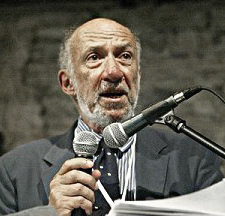
Prefatory Note:
What follows is a letter to the NY Times responding to their editorial of June 6, 2014, which was not accepted for publication. I publish it here as a post because I believe it identifies some of the continuing ways in which public opinion on the relationship between Israel and Palestine continues to be distorted on Israel’s behalf in American media sources that have the undeserved reputation of being objective and trustworthy. The New York Times has long ranked high on this list, if not at its top!
This letter is particularly concerned with the misleading characterizations of Hamas, and the failure to pass judgment on the Netanyahu leadership as ‘extremist.’
*****************
To the Editor, New York Time
Re “Israeli-Palestinian Collision Course” (editorial, June 6, text reproduced below):
You are correct that this is an opportune time to take account of Israel-Palestine peace prospects in light of failed direct negotiations and subsequent developments. It is misleading, however, to equate Israel’s accelerated expansion of settlements with the formation of the Fatah-Hamas unity government. Israeli action continues a pattern of flagrant violation of the 4th Geneva Convention while the Palestinian action is a constructive move that could finally make diplomacy on behalf of all Palestinians legitimate and effective. Read the rest of this entry »
The world right now: A Mid-Year Report
By Johan Galtung

Time to take stock. The shot in Sarajevo 100 years ago inspires narratives of 19-year old Gavrilo Princip killing the successor to the throne of an empire and his pregnant wife as the event unleashing mutual mass murder (INYT, FAZ 28-29 June 2014). Not the empire annexing Bosnia-Herzegovina on October 6, 1908 (Art. 25 of the 1878 Berlin Congress of “great powers”).
Maybe the inhabitants did not like it?
Moral of that stock-taking: watch out for terrorism, not for empires and occupation-colonialism; and protect leaders, not people.
ISIS (Islamic State of Iraq and the Levant, alternatively translated as Islamic State of Iraq and Syria and Islamic State of Iraq and al-Sham) comes up. TIME 30 June: The End of Iraq. Maybe Iraq – that highly artificial English colonial entity encasing Shia Arabs, Sunni Arabs and Sunni Kurds–never started?
Like its French colonial neighbor Syria – adding Alawite Arabs, Christians, Jews and others? Ever heard about Sykes-Picot and their czarist Russian allies?
Can such crimes just pass, with no counter-forces?
Watch out, a key point about ISIS – now comprising a major part of IS – is as a bridge over the English-French colonial divide, in favor of a Sunni Arab caliphate. Like it or not, these are very strong forces from the past in the daylight of the present. Read the rest of this entry »
 Posted in Africa, Asia, Buddhism, China, Conflict and war, Culture & religion, Development, EU politics, European Union, Ex Yugoslavia, Ex-Yugoslavia/Balkans, Future perspectives, Global trends & events, Iran, Iraq, Israel/Palestine, Japan, Johan Galtung, Media perspectives, North and South Korea, Pro-peace & proposals, Russia, South America, Syria, Thailand, US Empire, World order/governance |
  No Comments »
TFF PressInfo: If militarism continues, humankind is doomed
By Jan Oberg

Both NATO and the EU has just announced that their members will now invest more in the military. It’s indicative of the lack of creativity in both organisations, it is self-defeating and counter-productive.
But have you seen it put on top of any agenda and debated? You haven’t, it is so normal – and the argument is that we are threatened. That’s called fearology: Making tax payers pay even more by making them scared.
The military sector is a parasite on society
The military sector produces much less employment than the civilian per invested dollar. It’s a huge burden on the economy because it swallows creativity, research and development badly needed to solve humankind’s real problems.
Weapons don’t belong to a market, there is no competition – the state is the only buyer – and thus tax payers must cover the systematic cost overruns.
We are told that there is economic crisis and we must cut down on hospitals, schools and human care everywhere. But this we can afford?
But what if the military did solve our problems? Read the rest of this entry »
Worse world or better world?
By Jonathan Power

War is all over the place. It seems. Not just Syria and Iraq but now inside Pakistan. Not to mention Somalia and Sudan. Yet paradoxically there has never been less war.
Sweden’s Uppsala University Conflict Data program is about to publish its results for 2013. It reports that the number of conflicts in the world increased by one between 2012 and 2013 – pace all the press and TV coverage which sometimes gives the impression that half the world is going up in smoke.
Since the Cold War ended the number of conflicts claiming more than 1,000 deaths has declined by 50%. There were 15 conflicts of this size in the early 1990s. Today there are only seven.
In 2013 six peace agreements were signed – which is two more than the year before.
The number of democratic countries was 69 at the end of the Cold War. Today there are around 120. The number of autocracies has declined in that time from 62 to 48.
The American foreign policy elite appears unaware of these trends. Read the rest of this entry »
Posted in Democracy - local & global, Development, Disarmament, Environmental concerns, Future perspectives, Global trends & events, Jonathan Power, Media perspectives, Nuclear weapons, Pro-peace & proposals, Russia, Security and defence, UN matters, US Empire, World order/governance |
No Comments »
Force-feeding Palestinian hunger strikers
By Richard Falk
Palestine Hunger Strike and Israeli Force-Feeding Pending Legislation
The highly respected Israeli human rights NGO, Adalah, has issued an urgent appeal on behalf of a reported 125 Palestinian prisoners who are engaged in a hunger strike protesting their being held in Israeli jails on the basis of ‘administrative detention’ procedures.
It is the longest collective hunger strike in Palestinian history.
Administrative detention is an objectionable practice by which individuals are held in prison, sometime for months or even years, without being informed of charges or facing trial. According to international law reliance on administrative detention is regarded as prohibited unless there are overwhelming reasons in the form of imminent and severe security threats to justify the failure to produce criminal charges and hold a trial.
Israel has made no such appeal, and appears to use administrative detention procedures routinely and against individuals who cannot be considered security threats.
The current hunger strike commenced on April 24, over 50 days ago. Continue reading here.
TFF PressInfo: Democracy’s crisis – 10 points
By Jan Oberg
Democracy is a core feature of Western society, normally understood as representative parliament – i.e. in free elections citizens vote for people to represent their interests for a parliament consisting of parties of which some form the government and some the opposition.
It’s not always included in the definitions that democracy requires a reasonable level of knowledge and information, freely available. For instance, one often hears that India is the world’s biggest democracy but 26% of the people are still illiterate (287 million people).
So the ”world’s largest democracy” also has the world’s largest population who can’t read and write. In comparison, China illiterate citizens make up about 3% and is regularly called a dictatorship.
Also, in a society where the persons running for office are – or have to be – extremely wealthy to pay for their campaign and where large corporations make multi-million dollar contributions to certain candidates (presumably not out of altruism), falls outside a reasonable definition of democracy – even though they may also not be dictatorships; there are many stations in-between the two.
Are young people giving up parliamentary democracy?
When I was in my high-school years – a few decades ago – and wanted to contribute to changing society for the better, the most natural thing to do – and the finest – was to join a political party. Not so today. My students in peace studies around the world often ask me at the end of a course and it is time to say goodbye whether I can help them somehow in making their career. Their career dreams may be to work for the UN, for human rights, the environment or starting their own NGO with a peace profile or set up their own consultancy firm for a better world.
Significantly, over all these years, only one single student asked me what I thought about contributing to peace and development by becoming a politician.
As is well-known, people today engage in social issues mainly through civil society and the use of social media as their primary tool. This is good from most perspectives and holds fascinating prospects for de facto global citizenship and action, but it does something to the old type of representative democracy.
When we talk about global crisis, people think much more of the environment, identity issues or warfare than of democracy being in crisis. I think it is in fundamental crisis for the the following reasons. Read the rest of this entry »
Posted in China, Democracy - local & global, Ethics and values, EU politics, European Union, Future perspectives, Global trends & events, India, India, Jan Oberg, Media perspectives, Nonviolence, Political, Pro-peace & proposals, Reflections, essays & more, TFF PressInfo, US politics & security, World order/governance |
No Comments »
Mexico: 50 Peaceful Peace Policies
By Johan Galtung & Fernando Montiel
Toluca, Estado De México; Workshop on Drug Traffic and Violence
Background
300.000 kg of cocaine to USA via Mexico annually; 60% of marijuana producers had lived in misery, US$ 2/day; the drug traffic profit in Mexico was US$ 59 billion, 5% of GNP; 80% was spent on corruption; 125,000 were arrested since 2006; with an impunity of 98%.
Background
2,000 weapons from USA to Mexico daily; 5.5 million legal and 20 million illegal arms in Mexico; 100,000 have died in the “war on drugs” from 2006; 30,000 disappeared; 42+ journalists killed (more than in Afghanistan); 50,000 military troops involved by 2006, 130,000 by 2009, 50,000 in 2012, 32,000 in 2013; US$ 16.6 billion spent on insecurity and violence, 1.34% of GNP.
Conclusion
Due process of law and violence did not reduce drug traffic and violence; a drug-arms-violence-police-military complex had evolved. No general prevention, maybe not even individual prevention. A discourse-change took place: the perpetrators were seen less as evil and more as products of the domestic and regional contexts. The new approach was prevention by eliminating causes. The goal is reduction of drug traffic and of violence, and even if related they were seen as two different goals not necessarily served by the same means.
Question
Which are these means, causes to be handled? Read the rest of this entry »
TFF PressInfo: Psyko-politik i tiden för imperiets nedgång
Av Jan Öberg
Lund , Sverige – 23 maj 2014
Tiden för rationell politik, om begreppet någonsin funnits, är över .
”Realpolitik” har blivit en blandning av marknadsförda ord, propaganda och ledare som gör uttalanden som gränsar till absurd teater. Tunnare och tunnare länkar till Realiteten.
Detta är vad som händer när man förnekar nedgången.
Alla imperier går ner. Det amerikanska imperiet är på nedgång. Makrohistoriker (se t.ex. British Arnold Toynbee’s 12–volymarbete 1934-1961) berättar att det finns många skäl till att imperier faller:
• militarism med konstant krigföring;
• överutvidgning – försöka kontrollera mer än vad du kan hantera;
• förlust av legitimitet i andras ögon;
• strukturella ekonomiska kriser;
• moraliskt förfall;
• förlust av intellektuell och teknisk innovation;
• andra maktstrukturer ökar i styrka över tid och göra saker på nya, kreativa sätt .
Efter 1945 ansågs USA vara starkt på en rad olika maktdimensioner: militär, ekonomi, politik, legitimitet, kultur, innovation. Idag är de bara nummer ett på den militära dimensionen. När alla andra indikationer går ner, blir militären en stor börda som bara accelererar nedgången.
USA är på tillbakagång och i förnekelse. Så är även de flesta av dess allierade och sympatisörer .
Deras utrikes politiska beslutsfattare verkar tro att allt är bra och de kan ändå leda och forma världen enligt deras intresse och världsbild. Det är fortfarande i grunden en missionär .
Här är några delar av vad den består av: Read the rest of this entry »
Posted in Academia and science policies, Conflict and war, Culture, Democracy - local & global, Development, Ethics and values, Future perspectives, Global trends & events, Jan Oberg, Media perspectives, Military - technology, Nonviolence, NORDIC - NORDISKA artiklar, Nuclear weapons, Pro-peace & proposals, Psychology - war & peace, Reflections, essays & more, Security and defence, TFF PressInfo, US Empire, US politics & security, USA, Violence-prevention, World order/governance |
No Comments »
TFF PressInfo: Psycho politics in the age of imperial decline
By Jan Oberg
Lund, Sweden – May 23, 2014
The time of rational politics, if it ever existed, is over.
”Realpolitik” has become a mixture of marketing soundbites, propaganda and leaders making statement that borders on the Theatre of the Absurd. Thinner and thinner links to Real-ity.
This is what happens when decline in being denied.
All empires go down. The U.S. empire is in decline. Macro historians (see e.g. British Arnold Toynbee’s 12-volume work 1934-61) tell that there are many reasons when empires fall:
• militarism with constant warfare;
• overextension – trying to control more than you can manage;
• loss of legitimacy in the eyes of others;
• structural economic crisis;
• moral decay;
• loss of intellectual and technological innovation and
• simply other powers gaining strength over time and doing things in new, creative ways.
After 1945 the U.S. was considered strong on many power dimensions: military, economics, politics, legitimacy, culture, innovation. Today, it is only clearly Number One on the military dimension. When all the other indicators go down, the military becomes a huge burden and only accelerates the decline.
The U.S. is in decline and denial. So are most of its allies and sympathizers.
Its foreign policy-makers seem to assume that everything is fine and they can still lead and shape the world according to their interest and worldview. It remains fundamentally a missionary.
Here is some elements of what it consists of: Read the rest of this entry »
Homage to International New York Times
By Johan Galtung
On the table are some old clippings mainly from that remarkable paper; in my mind the International Herald Tribune, IHT, from 1857 and a part of my reality for about fifty years. Maybe an addiction? Hard to live without. The recent name change to International New York Times was understandable but too specific geographically, not global. The Honolulu papers, well located, are often more global.
Why homage? Not for the news coverage; usually the news “fit to print”. The news that do not contradict too openly the world views carried by US and Israeli foreign policies, even if this has improved considerably recently. Nor for the editorials, they are usually on the same line and also, sorry, frankly, often boring.
No, the homage is for the articles, essays even, at a very high level in what is after all a newspaper, a paper with news. Those essays often carry discourses that are wide ranging, way back into the past, far into the future. We are not talking about agree-disagree but about broadness, openness, even globally.
Take William Safire 30 September, 1991 Read the rest of this entry »