Archive for the ‘Syria’ Category
No to US military intervention in Syria
 June 25th, 2013 |
  Author:
 By Jonathan Power

The fog of war in Syria descends. Alliances on the ground come and go. America wobbles. Europe wrings its hands. Russia ups its military commitment, fearful of an arc of Sunni militancy that will make common cause with Russia’s own fundamentalists in Chechnya and Dagestan. Much of the rest of the world looks on with half shut eyes.
The debate swirls. Can the West have any profound impact on the Syrian civil war? Can it help depose the Assad regime? Does it really think it can influence the making of a democratic, multi-ethnic, multi-religious, Syria? Is President Barack Obama, after months of resisting the sirens calling for military support of the rebels, beginning to think it can play a more important part than hitherto? With the direct provision of American (and British and French) arms is he coming to believe that this will tilt the balance in the insurgents’ favour? Read the rest of this entry »
Yara Abbas in her own words
By Sharmine Narwani

Today I try to honor a young woman who made an impact on me in one meeting long ago. Syrian journalist Yara Abbas’ love for her country and the soldiers who protected her in combat zones humanized these young men for me, when it was altogether so easy to write them off with the rest of the media as killing machines.
I felt during our interview that she was out in the field protecting these boys as much as they were protecting her. And so she made me give them a second look. RIP.
Last week Yara Abbas was killed by a sniper. Here is Sharmine Narwani’s interview with her from last year. Yara was the 38th media casualty in the Syrian conflict…
Responding to the Syrian challenge
By Richard Falk

The issue facing the U.S. Government at this stage is not one of whether or not to intervene, but to what extent, with what objectives, and with what likely effects. More precisely, it is a matter of deciding whether to increase the level and overtness of the intervention, as well as taking account of what others are doing and not doing on the Assad regime side of the conflict. Roughly speaking, there have been interventions by the Turkey, the United States, Qatar, Saudi Arabia, Israel, and the EU on the insurgent side, and by Russia, Iran, Hezbollah on the regime side, with a variety of non-Syrian ‘volunteers’ from all over being part of the lethal mix.
From an international law perspective the issues are blurred and controversial, both factually and jurisprudentially. The Assad government remains the government of Syria from most international perspectives, despite having repeatedly perpetrated the most despicable crimes against humanity. Such behavior has eroded Syria’s status as a sovereign state Read the rest of this entry »
Midest backlashes yet to come
By Sharmine Narwani
The Middle East is treading water these days. Two years of rhetoric about ousting dictators, revolution, freedom, honor, dignity, and democracy – without result – has people on edge, their disillusionment now demanding an outlet.
There are no outlets though. Sensing the fast-growing disenchantment with undelivered promises, even the “bright new leaders” are tightening the reins and demanding compliance.
These new heads of state simply can’t deliver the goods for one main reason: they are just as caught up in global and regional power contests as were their predecessors. Nothing has changed with these uprisings. Nothing! Read the rest of this entry »
 Posted in Arab Spring, Egypt, Future perspectives, Iran, Iraq, Israel/Palestine, Lebanon, Middle East, Sharmine Narwani, Syria |
  No Comments »
Rethinking ‘Red lines”
By Richard Falk
There are widespread reports circulating in the media that President Obama had not fully appreciated the political consequences of responding to a question at an August press conference that asked about the consequences of a possible future use of chemical weapons by the Assad regime. Obama replied that such a use, should it occur, would be to cross ‘a red line.’ Such an assertion was widely understood to be a threat by Obama either to launch air strikes or to provide rebel forces with major direct military assistance, including weaponry.
There have been sketchy reports that Syria did make some use chemical weapons, as well as allegations that the reported use was ‘a false flag’ operation, designed to call Obama’s bluff. As the New York Times notes in a front page story on May 7th, Obama “finds himself in a geopolitical box, his credibility at stake with frustratingly few good options.” Such a policy dilemma raised tactical issues for the U.S. Government about how to intervene in the Syrian civil war without risking a costly and uncertain involvement in yet another Middle Eastern war. Not responding also raises delicate questions of presidential leadership in a highly polarized domestic political atmosphere, already shamelessly exploited by belligerent Republican lawmakers backed by a feverish media that always seem to be pushing Obama to pursue a more muscular foreign policy in support of alleged America’s global interests, as if hard power geopolitics still is the key to global security.
What is missing from the debate on Syria, and generally from the challenge to American foreign policy, is a more fundamental red line that the United States at another time and place took the lead in formulating – namely, the unconditional prohibition of the use of international force by states other than in cases of self-defense against a prior armed attack. Read the rest of this entry »
Syria: U.S. involvement could make things even worse
By Stephen Zunes
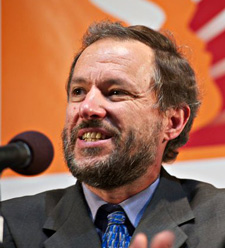
A comprehensive analysis by Zunes of chemical weapons in the Middle East and U.S. policies in this regard can be found here
The worsening violence and repression in Syria has left policymakers scrambling to think of ways our governments could help end the bloodshed and support those seeking to dislodge the Assad regime. The desperate desire to “do something” has led to increasing calls for the United States to provide military aid to armed insurgents or even engage in direct military intervention, especially in light of the possible use of chemical weapons by the Syrian regime.
The question on the mind of almost everyone who has followed the horror as it has unfolded over the past two years is, “What we can do?”
The short answer, unfortunately, is not much.
This is hard for many Americans to accept. Read the rest of this entry »
Syria – toward a Swiss solution?
By Johan Galtung

We all feel desperate watching the horrible killing, feeling the suffering of the bereaved, the whole people. But, what to do?
Could it be that the UN, and governments in general, have a tendency to make the same mistake, again and again, of putting the cart before the horse? The formula they use is generally:
1. Get rid of No. 1 as key responsible, using sanctions; then
2. Cease-fire, appealing to the parties, or intervening, imposing;
3. Negotiation among all legitimate parties; and from that
4. A political solution as a compromise between the positions.
It looks so logical. There is a key responsible, President Assad, ordering the killing; get rid of him by all means. Then the cease-fire, the fire ceasing; then negotiation, and then the solution emerges. Logical, yes; but maybe not very wise. Read the rest of this entry »
The Chemical Weapons Charade in Syria
By Sharmine Narwani
Let us be clear. The United States can verify absolutely nothing about the use of chemical weapons (CWs) in Syria. Any suggestion to the contrary is entirely false.
Don’t take it from me – here is what US officials have to say about the subject:
A mere 24 hours after Washington heavyweights from the White House, Pentagon, and State Department brushed aside Israeli allegations of chemical weapons use in Syria, US Secretary of Defense Chuck Hagel and the White House changed their minds. They now believe “with varying degrees of confidence” that CWs have been used “on a small scale” inside Syria.
For the uninitiated, “varying degrees of confidence” can mean anything from “no confidence whatsoever” to “the Israelis told us” – which, translated, also means “no confidence whatsoever.”
Too cavalier? I don’t think so. The White House introduced another important caveat in its detailed briefing on Thursday:
“This assessment is based in part on physiological samples. Our standard of evidence must build on these intelligence assessments as we seek to establish credible and corroborated facts. For example the chain of custody is not clear so we cannot confirm how the exposure occurred and under what conditions.”
“The chain of custody is not clear.” That is the single most important phrase in this whole exercise. It is the only phrase that journalists need consider – everything else is conjecture of WMDs-in-Iraq proportions.
I asked a State Department spokesperson the following: “Does it mean you don’t know who has had access to the sample before it reached you? Or that the sample has not been contaminated along the way?”
He responded: “It could mean both.” Read the rest of this entry »
Shipping death and destruction to Syria
By Sharmine Narwani
“The weapons of choice in (today’s) new conflicts are not big-ticket items like long-range missiles, tanks, and fighter planes, but small and frighteningly accessible weapons ranging from handguns, carbines, and assault rifles on up to machine guns, rocket-propelled grenades, and shoulder-fired missiles,” explained William Hartung more than a decade ago in an article entitled The New Business of War.
“Because they are cheap, accessible, durable, and lightweight, small arms have been a primary factor in the transformation of warfare from a series of relatively well- defined battles between ‘two opposing forces wearing uniforms’ to a much more volatile, anarchic form of violence,” says Hartung, now director of the Arms and Security Project at the Center for International Policy in Washington DC. “More often than not, today’s wars are multisided affairs in which militias, gangs, and self-anointed “rebels” engage in campaigns of calculated terror, civilian targets are fair game, and the laws of war are routinely ignored.”
“The ready availability of small arms makes these conflicts far more likely to occur, far more deadly once they start, and far more difficult to resolve once the death tolls mount and the urge for revenge takes hold.”
Hartung could have been describing Syria today. And no – the anarchic, violent rebels he describes in his article do not appear everywhere else in the world except in Syria. They are the Syrian prototype. Read the rest of this entry »
Posted in Armament, International law, Media & conflict, Middle East, Sharmine Narwani, Syria, Terrorism, US Empire |
No Comments »
The UN Arms Trade Treaty is not perfect
By Jonathan Power
US presidential candidate Jimmy Carter described arms sales as a “cancer”. But once in office Carter achieved little in controlling them.
In President Bill Clinton’s first term Amnesty International questioned the US government about the use of American military helicopters and armoured vehicles involved in human rights abuses in Turkey. Under pressure from Congress the State Department compiled a report on human rights violations by the Turkish armed forces. It concluded there was “highly credible” evidence that US-supplied arms and jet fighters had been used to subdue Kurdish villages.
Later, in 1996, the US temporarily suspended the sale of advanced attack helicopters. But two years later there were fresh reports that hundreds more armoured vehicles had been sold. The US Defence Secretary visited Turkey and reportedly lobbied on behalf of American companies wishing to co-produce advanced helicopters there. In that same year an American company sold 10,000 electric shock weapons to the Turkish police.
Read the rest of this entry »
Posted in Armament, Development, Disarmament, International law, Jonathan Power, Libya, Military - technology, Syria |
No Comments »