Archive for the ‘Middle East’ Category
TFF PressInfo: Sverige – inte längre aktör för en bättre värld
 May 4th, 2014 |
  Author:
 Av Jan Öberg
Dr.hc., direktör för TFF
4 maj 2014
Eliten i Sverige är mer lojal mot Nato, USA och EU än mot sitt folk
• Under de senaste 25-30 åren har Sveriges militära, säkerhets- och utrikespolitiska elit vridit Sveriges politik 180 grader.
• Dessa grundläggande förändringar inleddes av den socialdemokratiska regeringen under Göran Persson och utrikesminister Anna Lindh och har genomförts praktiskt taget utan offentlig debatt.
• Omsvängningen till interventionism, militarism och USA/Nato på alla områden har planerats gradvis, i smyg och ohederligt – kort sagt på ett sätt som är ovärdigt en demokrati.
• Denna elit är mer lojal mot Bryssel och Washington än mot svenskarna.
• Om din bild av Sverige är att det är ett progressivt, förnyande och fredsfrämjande land med global inställning som försvarar folkrätten så är den – tråkigt nog – föråldrad.
Hur Sverige har förändrats
Sverige är inte längre neutralt och det är bara formellt alliansfritt; det finns ingen mer närstående bundsförvant än USA/Nato. Landet har upphört att utveckla en egen politik och positionerar istället sig inom ramen för EU och Nato. Landet bidrar inte längre med betydelsefullt nytt tänkande – det sista var Olof Palmes kommission om gemensam säkerhet (1982). Read the rest of this entry »
 Posted in Abolition, Academia and science policies, Alternatives - peace, Conflict and war, Democracy - local & global, Disarmament, Ethics and values, Ex Yugoslavia, Foreign and security politics, Future perspectives, Georgia, International law, Iraq, Jan Oberg, Libya, Media & conflict, Media perspectives, Nonviolence, Norden as region, NORDIC - NORDISKA artiklar, Nuclear weapons, Peace, Psychology - war & peace, Russia, Sanctions, Security and defence, Sweden, Syria, TFF PressInfo, Ukraine, UN matters, US Empire, USA, World order/governance |
  Tags: Anna Lindh, Carl Bildt, common security, disarmament ambassador, gemensam säkerhet, Göran Persson, interventionism, NATO, neutrality, Olof Palme, Prtnership for Peace, Sweden cruise missiles |
  No Comments »
TFF PressInfo – The West’s hypocrisy in Ukraine
By Jonathan Power
April 29th 2014
When it comes to Ukraine the US and the EU are adopting a holier than thou attitude which, unfortunately, leads them not to worship at the alter of truth.
Take the issue of the fuss made over alleged soldiers wearing Russian uniforms. They are not dressed in the smart fatigues of the unmarked Russian soldiers in Crimea, about which President Vladimir Putin has acknowledged he misled us. What these soldiers, leading the Russian-speaking revolt, are wearing can be bought in any army surplus store. As for the photos Western intelligence has persuaded much of the media to use as evidence, they are hazy and would not be admissible in a court of law.
The Ukranian Security Agency announced that it captured 20 of its Russian counterparts. But then it reduced the number to 10 and then to 3. But the last figure received much less highlighting from Western governments and media than the first.
How all this “Russian interference” compares with the post Cold War expansion by Nato forces up to Russia’s borders, senior Western politicians’ (including the US ambassador) provocative support for a revolutionary movement that included a healthy contingent of neo-fascists who now have seats in the Ukrainian cabinet, and the funding of opposition forces and NGOs, is to be wondered at. (I’ve long been surprised at the tolerance for Western NGOs based in Russia and China. Imagine the reverse.) Read the rest of this entry »
Time to sanction Israel
By Jonathan Power
US Secretary of State John Kerry’s foray into the politics of peace between Israel and Palestine appears to have run aground despite his tireless and single minded efforts. It is clear that Israel’s Prime Minister Benjamin Netanyahu never believed in it.
Israelis often see their predicament as David against Goliath. In truth it is the reverse. Contrary to popular belief Israel had larger, better equipped and better led forces, during the 1947 war of independence against the joint Arab armies. The Israeli Defence Forces won quick and easy victories against Egypt in 1956 and against Egypt, Jordan and Syria in 1967. All this was done before US aid starting flowing in large amounts. Few doubt it has overwhelming power today, not forgetting its sizeable armoury of nuclear weapons.
Another way to look at the David/Goliath analogy is to look at child deaths as a result of the conflict. The ratio of Palestinian to Israeli children killed is 5.7 to 1. Read the rest of this entry »
The New World Order?
By Richard Falk
There is no more reliable guardian of entrenched conventional wisdom than The Economist. And so when its cover proclaims ‘the new world order,’ and removes any ambiguity from its intentions, by its portrayal of Putin as a shirtless tank commander with menacing features.
No such iconography accompanied the last notable invocation of the phrase ‘new world order’ by George H. W. Bush in mobilizing support for a forcible response to the Iraqi invasion and annexation of Kuwait in 1990, the dirty work of Saddam Hussein. Read the rest of this entry »
Posted in Abolition, Afghanistan, Democracy - local & global, Disarmament, Ex-Yugoslavia/Balkans, Future perspectives, International law, Iran, Iraq, Kosovo/a, Libya, Media & conflict, Media perspectives, Middle East, Nuclear weapons, Richard Falk, Russia, Sanctions, Security and defence, UN matters, US Empire, US politics & security, USA, Violence-prevention, World order/governance |
No Comments »
Moratorium on comments addressing the Israel/Palestine struggle
By Richard Falk
It has always been my intention to make the tiny fragment of the blogosphere that I inhabit a site for civil discourse on a wide spectrum of concerns, issue oriented interpretations of what is transpiring in the world.
Recently the comments sections has narrowed from this perspective into a dialogue between adversaries, several of whom seem preoccupied with, if not obsessed by, Israel, the Jewish experience, Zionism, and the Palestinian/Arab narrative and counter-narrative. Some of the contributions have been learned and sensitive to the reality that there are many diverse voices that need to be heard on this inflamed subject-matter, yet others have been intolerant, launched repeated personal attacks questioning motives and motivations, and have created a polemical aura at the site that has inhibited participation by those with other interests, concerns, and style.
For these reasons, I have decided to have a moratorium on all comments relating to this subject-matter until May 1, 2014.
I expect this might be troublesome for several faithful readers of my posts. Please bear with me, and understand this to be an effort to encourage more varied and less antagonistic exchanges.
I am suspending this portion of the comments section at a moment that coincides with the ending of my six-year term as Special Rapporteur on Palestine for the UN Human Rights Commission.
Let me add that I will continue to do my best to remain engaged in the struggle to find a just and sustainable peace for both peoples premised upon their equality.
The obsolescence of ideology: Debating Syria and Ukraine
By Richard Falk
I have been struck by the unhelpfulness of ideology to my own efforts to think through the complexities of recommended or preferred policy in relation to Syria, and more recently, the Ukraine. There is no obvious posture to be struck by referencing a ‘left’ or ‘right’ identity. A convincing policy proposal depends on sensitivity to context and the particulars of the conflict.
To insist that the left/right distinction obscures more than it reveals is not the end of the story. To contend that ideology is unhelpful as a guide for action is not the same as saying that it is irrelevant to the public debate. In the American context, to be on the left generally implies an anti-interventionist stance, while being on the right is usually associated with being pro-interventionist. Yet, these first approximations can be misleading, even ideologically. Liberals, who are deliberately and consigned to the left by the mainstream media, often favor intervention if the rationale for military force is primarily humanitarian.
Likewise, the neocon right is often opposed to intervention if it is not persuasively justified on the basis of strategic interests, which could include promoting ideological affinities. The neocon leitmotif is global leadership via military strength, force projection, friends and enemies, and the assertion and enforcement of red lines. When Obama failed to bomb Syria in 2013 after earlier declaring that the use of chemical weapons by the Assad regime was for him a red line this supposedly undermined the credibility of American power.
My point is that ideology remains a helpful predictor of how people line up with respect to controversial uses of force, although relying on ideology is a lazy way to think if the purpose is to decide on the best course of action to take, which requires a sensitivity to the concrete realities of a particular situation. Such an analysis depends on context, and may include acknowledging the difficulties of intervention, and the moral unacceptability of nonintervention. Read the rest of this entry »
Posted in Conflict and war, Ethics and values, Ex Yugoslavia, Ex-Yugoslavia/Balkans, Global trends & events, Human rights and justice, International law, Iran, Iraq, Israel/Palestine, Kosovo/a, Nuclear weapons, Political, Richard Falk, Russia, Sanctions, Security and defence, Syria, Ukraine, UN matters, US Empire, US politics & security, USA, Violence-prevention, World order/governance |
No Comments »
TFF PressInfo: The manufactured story about Iran’s nuclear program
By Farhang Jahanpour
As Iran and the world powers resume nuclear talks in Vienna with the hope of reaching a comprehensive agreement over Iran’s nuclear program by mid-July, the Israelis and their lobbyists in Washington are intensifying their efforts to scuttle the talks. In addition to all the efforts in the US Congress to impose additional sanctions on Iran, thus bringing the talks to a premature end, there are indications that Israel and her friends are continuing with various acts of sabotage against Iranian nuclear facilities.
In 2010, the so-called Stuxnet virus temporarily disrupted the operation of thousands of Iranian centrifuges. At least five Iranian nuclear scientists have been assassinated. Iran has also said that it has discovered tiny timed explosives planted on centrifuges but has disabled them before they could go off. On Monday 17 March 2014, Iran said that an alleged attempt to sabotage one of its nuclear facilities had involved foreign intelligence agencies that had tampered with imported pumps. However, in addition to all those acts of sabotage, there seems to be an intensive effort to manufacture a crisis by means of false intelligence.
Prior to the devastating Iraq war that destroyed the country and killed upwards of half a million people, not to say anything of thousands of Coalition forces who were killed and the two trillion dollars that was spent, a number of neocons bent on the invasion of Iraq manufactured various false reports in order to mislead the public and pave the way for the war.
On September 8, 2002, Michael R. Gordon and Judith Miller published a story in the New York Times that openly alleged that Saddam Hussein had intensified his quest for a nuclear bomb. They wrote: “In the last 14 months, Iraq has sought to buy thousands of specially designed aluminum tubes, which American officials believe were intended as components of centrifuges to enrich uranium… Bush administration officials say the quest for thousands of high-strength aluminum tubes is one of several signs that Mr. Hussein is seeking to revamp and accelerate Iraq’s nuclear weapons program.”
The unsuspecting public was misled by that false intelligence and the result was one of the longest and most disastrous wars in US history.
How the manufactured crisis was manufactured
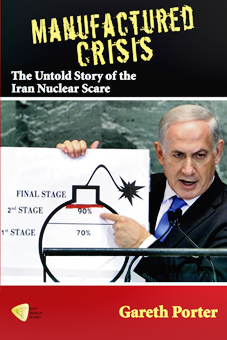
In his latest groundbreaking book, entitled A Manufactured Crisis: The Untold Story of Iran Nuclear Scare, the historian and investigative journalist Gareth Porter catalogs a long list of false reports manufactured by Israeli intelligence agencies in order to mislead the public and pave the way for a war against Iran. (1)
Posted in Abolition, Democracy - local & global, Egypt, European Union, Farhang Jahanpour, General issues, Human rights and justice, International law, Iran, Iraq, Israel/Palestine, Middle East, Military - technology, Negotiations, New books, Nuclear weapons, Security and defence, Syria, TFF PressInfo, Uncategorized, US Empire, US politics & security, USA |
Tags: A Manufactured Crisis, antiwar.com, Bandar Abbas, BBC, BND, deal with Iran, Dodgy Dossier, Douglas Feith, Gaza, German intelligence, Hassan Rouhani, IAEA, Iran's nuclear program, Jim Lobe, Judith Miller, Karsten Voigt, Katrine A, Lobe Blog, Mohammad Javad Zarif, Mojahedin-e Khalq, Paul Wolfowitz, Peter Jenkins, Port Sudan, ship to gaza, Sinai, Stuxnet, The Real News, U.N. Security Council, Yasser Arafat |
No Comments »
Why do I persist?
By Richard Falk
I have been asked recently why do I persist in working hard for the things that I believe in, knowing that I will die in the next several years, and am almost certain not to be around for the catastrophic future that seems to cast its dark shadow across the road ahead, and can only be removed by a major transnational movement of the peoples of the world.
Similarly, why do I accept the defamation and related unpleasantness that accompanies my efforts to be a truthful witness of the sufferings endured by the Palestinian people in the course of their struggle for freedom and in violation of their fundamental rights? Some friends pointedly suggest ‘why don’t you just sit back, enjoy the pleasures of an easy life, and if still restless and alert enough, devote yourself to the narcissisms of producing a memoir?’
Or at least, why not at least indulge the self-exploratory pleasures of proving to myself that I am a decent poet or that I can still improve my chess or that, appearances to the contrary, I am still not too old to learn Turkish? At worst, I could continue to write barbed comments on the passing scene from the relative safety and comfort of the blogosphere, and to relieve the monotony of a virtual life, take occasional cruises to exotic destinations seeking out ‘ships of fools.’
Several prominent philosophers have attempted to answer such generic questions in a book recently published with the alluring title of Death and the Afterlife (Oxford University Press, 2013). It contains three lectures given by Samuel Scheffler, two at the Berkeley campus of the University of California and the third at the University of Utah, as well as a series of generally laudatory commentaries by four other distinguished philosophers and a response at the end by Scheffler.
The core argument developed by Scheffler is that human beings care more about the collective survival of humanity than they do about either their own personal immortality or even about the survival of those that they love and befriend, that is, those who are closest to us in our present life.
This rather novel line of inquiry investigates the implications of a thought experiment that supposes the extinction of the human species either due to ‘a doomsday scenario’ in which life on the planet is brought to an end or ‘an infertility scenario’ in which all women stop having the capacity to bear children. Read the rest of this entry »
Report to UN Human Rights Council on Occupied Palestine
By Richard Falk
This is my last report as Special Rapporteur on Occupied Palestine as my term is coming to an end after six years.
The mandate is important as a source of information pertaining to the realities of occupation from the perspective of international humanitarian law and international criminal law. My hope is that this mandate can be brought to an end as early as possible, but not earlier than when Palestinians can live in equality with the Israelis either in a single bi-national state or in separate states. It is a matter that need to be decided by the two peoples in accordance with respective rights. No solution can be imposed or negotiated in a setting that is not premised on the equality of the peoples.
Read Falk’s report here as well as follow the debate on his blog.
Iran nuclear negotiations almost in the bag
By Jonathan Power
It was the Americans, back in the time of the deposed Shah, who encouraged Iran to develop a nuclear bomb-making capacity. Now it is the Americans, along with the Europeans, who are desperately trying to undo their folly.
They are nearer the goal than they think- or, rather, let on. Perhaps they are playing their cards too close to their chest? Is this what is necessary for the Administration to position itself to assuage Congressional opinion?
As long as both Iran and the US make sure, as the saying goes, they don’t “miss an opportunity to miss an opportunity” they should get home and dry well before the end of the six months allowed to complete final negotiations.
A word on the Iranian side: The Supreme Leader, Ayotallah Ali Khameini, who is ultimately the deciding figure, has long ago made his position clear. He has said on more than one occasion, indeed has issued a fatwa to this effect, that to possess nuclear weapons goes against God. Iran is a highly religious nation and these words of his cannot be taken lightly. He cannot put them on one side, even if the Americans prove difficult. Moreover, we have the statements of US intelligence of 2007 and repeated twice since that Iran has abandoned its nuclear weapons program.
If all this be true why don’t the delegates go home and put their feet up? Read the rest of this entry »