Archive for the ‘Middle East’ Category
What can be done about Syria? Tragedy and impotence
 June 1st, 2012 |
  Author:
 By Richard Falk
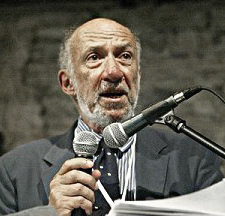
The Houla Massacre of a week ago in several small Muslim villages near the Syrian city of Homs underscores the tragic circumstances of civilian vulnerability to the brutal violence of a criminal government. Reliable reports confirm that most of the 108 civilians who died in Houla were executed at close range in cold blood, over 50 of whom were children under the age of 10.
It is no wonder that the Houla Massacre is being called ‘a tipping point’ in the global response to this latest horrifying outbreak of Syrian violence, a process that started over 15 months ago. The chilling nature of this vicious attack that refused to spare the most innocent among us, young children, does seem like a point of no return. Read the rest of this entry »
Bipartisan assault on Middle East peace
By Stephen Zunes
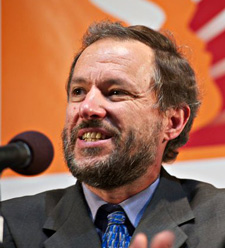
Earlier this month, the House of Representatives passed a dangerous piece of legislation (H.R. 4133) which would undermine the Israeli-Palestinian peace process, weaken Israeli moderates and peace advocates, undercut international law, further militarize the Middle East, and make Israel ever more dependent on the United States.
The margin was an overwhelming 411-2, with eight abstentions.
House minority leader Steny Hoyer (D-MD) and Howard Berman (D-CA), the ranking Democrat on the House Foreign Affairs Committee, joined House Majority leader Eric Cantor (R-VA) and House Foreign Affairs Committee chair Ileana Ros-Lehtinen (R-FL) in co-sponsoring the bill, an indication of how closely the Democratic Party leadership aligns with the most right-wing Republicans when it comes to U.S. Middle East policy. Read the rest of this entry »
An innocent victim of our sanctions against Iran
Or how “high” politics are connected to the lives of Iranians even abroad
By Jan Oberg
I’ve come to know a young Iranian student here in Sweden. Fortunately he came before the discriminatory law that forces students from outside EU to pay for their studies while those from inside the EU can study freely.
Kourosh – a name I use for the purpose of this article – is a very modest, diligent and polite young man. He has quickly learned to talk everyday Swedish. He sees his life in Sweden as a great privilege and an opportunity to go back to his native Iran and make it a better place. Since I have applied for a visa to go to Iran, I’ve been eager to meet with him and listen to what he can tell me about Iranian culture and about how life has been for his family. The father is a truck driver turned farmer; the family is not among the poorest but also not in the upper class. Read the rest of this entry »
What is new in the Israel-Palestine conflict?
By Richard Falk
Undoubtedly transfixed by the extraordinary developments throughout the Arab world since Mohamed Boazizi’s self-immolation on December 17, 2010: from Tahrir Square to the NATO intervention in Libya to bloody confrontations in Syria, Yemen, Bahrain to the eerie quiet in Algeria to the relative and temporary calm in Morocco, few have noticed that the Israeli/Palestine conflict has changed its character in fundamental respects during the last couple of years.
For some the first of these transformative developments may have been realized for somewhat longer, but now almost everybody knows, except for those in high places, especially in Washington and Tel Aviv who seem to have a political need not to know. Read the rest of this entry »
Goodbye to the Iran nuclear bomb?
By Jonathan Power
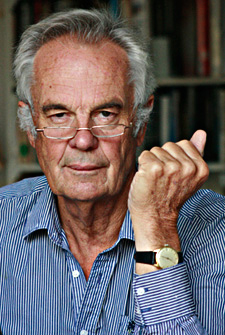
Is it agreement time in Iran? Is Iran going to bend to the will of the UN Security Council and engineer a compromise that will allow it to enrich uranium – but only to a small degree – in return for allowing the UN’s International Atomic Energy Agency to intimately monitor its nuclear industry to assure it doesn’t enrich further to enable it to build a nuclear weapon?
The West and Israel in particular have long been in a panic about a possible Iranian nuclear bomb. There is a strong “bomb Iran before it is too late” faction in the US Republican Party and even more so in Israel. This has never made sense if one reads the tea-leaves carefully. Read the rest of this entry »
 Posted in General issues, Iran, Jonathan Power, Middle East, Nuclear weapons, US Empire, Violence-prevention |
  No Comments »
The Nakba 2012
By Richard Falk
The recent parallel hunger strikes in Israeli prisons reignited the political imagination of Palestinians around the world, strengthening bonds of ‘solidarity’ and reinforcing the trend toward grassroots reliance on nonviolent resistance Israeli abuses.
The crisis produced by these strikes made this year’s observance of Nakba Day a moral imperative for all those concerned with attaining justice and peace for the long oppressed Palestinian people whether they be living under occupation or in exile. The Palestinian mood on this May 14th, inflamed by abuse and frustration, but also inspired by and justly proud of exemplary expressions of courage, discipline, and nonviolent resistance on the part of imprisoned Palestinians who are mounting the greatest challenge of organized resistance that Israel has faced since the Second Intifada. Read the rest of this entry »
Reflections on the great Palestinian prison strike of 2012
By Richard Falk
Ché Guevera was once asked what was at the root of his revolutionary commitment. His response, which we should all take some moments to reflect upon, “it is about love.” Reading the words of Khader Adnan (‘Open Letter to the People of the World’) and Thaer Halahleh (‘Letter to my Daughter’), or the comments of Hana Shalabi’s mother and sister, or Bilal Diab’s father, led me to recall Guevera’s illuminating comment. Only those with closed minds can read such words of devotion without feeling that the animating hunger of these Palestinians is for peace and justice, for love and dignity, and that their heroic strikes would have impossible without cherishing life and future freedom for the people of Palestine.
The nature of extreme self-sacrifice, provided it is autonomous and nonviolent, is an inherently spiritual undertaking even when its external appearance is political. For Christians, and others moved to tears by the life of Jesus, the Crucifixion exemplifies this encounter between the political and the spiritual.
We can only marvel at the duplicitous double standards of the media. Without the Internet and Al Jazeera the West, especially the United States, would have rendered invisible these challenges to Israeli abuses of human rights and international humanitarian law. Only the settlement of the strike, and to some extent fear of Palestinian unrest should one of these hunger strikes die while in detention, was deemed somewhat newsworthy by the Western press. Read the rest of this entry »
Is Al Qaeda on the up?
By Jonathan Power
The two bombs that went off last week in Damascus, Syria, killing 55 people suggest that Al Qaeda is out and about, not on the verge of defeat as appeared so after the death of Osama bin Laden. The movement that claimed to be responsible, the Al-Nusra Front, whilst independent, almost certainly has ties with Al-Qaeda. In an eight minute video released in February Dr Aymen Zawaheri, who took over from bin Laden, urged Muslims to help “brothers in Syria with all that they can”.
According to US intelligence Al Qaeda in Iraq responded by establishing terrorist cells in Syria. This is one reason why the US and Nato don’t want to get militarily involved in Syria. They have at last learnt that it would radicalise more people and push them towards Al Qaeda. (Besides, the situation is not as straightforward as it was in Libya with one all-powerful strongman, one dominant religious sect and a fairly united armed opposition.) Read the rest of this entry »
Rational conflict resolution: What stands in the way?*
By Johan Galtung
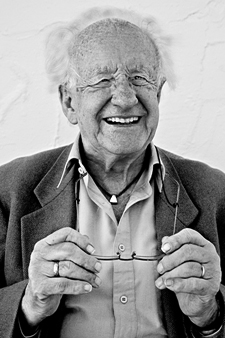
We are facing six conflicts, four current, one past and one future are shaping our present reality. Conflict is a relation of incompatibility between parties; not an attribute of one party. It spells danger of violence and opportunity to create new realities.
Thus, to understand the shoa the narratives of unspeakable German atrocity and infinite Jewish suffering are indispensable. But so are the narratives of German-Jewish relations, Germans to others, Jews to others. Failure to do so blocks rationality: if conflict is in the relation, then the solution is in a new relation. This is not blaming the victim. What matters most is changing the relation. Are we able? Read the rest of this entry »
Posted in Conflict and war, Culture & religion, EU politics/economics, Future perspectives, Global economics, Global trends & events, Human rights and justice, Iran, Israel/Palestine, Johan Galtung, New books, Nonviolence, Peace, Pro-peace & proposals, Reconciliation & forgiveness, US Empire, Violence-prevention, World order/governance |
No Comments »
Historic hunger strikes: Lightning in the skies of Palestine
By Richard Falk
There is ongoing militant expression of Palestinian resistance to the abuses of Israel’s 45 years of occupation and de facto annexation of the West Bank and East Jerusalem, and five year blockade of Gaza taking the form of a series of hunger strikes. Recourse to this desperate tactic of courageous self-sacrifice is an extreme form of nonviolence, and should whenever and wherever it occurs be given close attention.
Palestinians have protested by hunger strikes in the past but failed to inspire the imagination of the wider Palestinian community or shake the confidence of Israeli officialdom. Despite the averted gaze of the West, especially here in North America, there are some signs that this time the hunger strikes have crossed a historic threshold of no return.
These strikes started by the individual exploit of a single person, Khader Adnan, at the end of 2011. Dragged from his home in the village of Arraba near Jenin by a night raid by dozens of Israeli soldiers, humiliated and roughed up in the presence of his two- and four-year old daughters, carried away shackled and blindfolded, roughly interrogated, and then made subject to an administrative decree for the eighth time in his young life, Adnan’s inner conscience must have screamed ‘Enough!’ and he embarked on an open-ended hunger strike. Read the rest of this entry »