Archive for the ‘TFF PressInfo’ Category
TFF PressInfo # 317 – Will Iran kill the nuclear bomb deal?
 April 14th, 2015 |
  Author: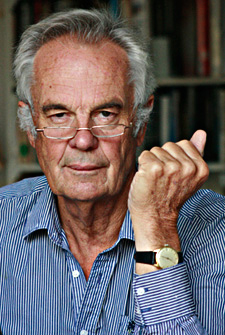
By Jonathan Power
Iran will find it easier to kill the nuclear bomb deal than will the Republicans in Congress. Why? Because the Republicans need some Democratic senators on their side to override a veto by President Barack Obama of a vote to bury the accord, whereas in Iran all that is needed is the decision of one man, the Supreme Leader, Ayatollah Ali Khamenei.
Iran is not a dictatorship – voters, parliament and president carry enormous weight but when it comes to the very big decisions it is Khamenei who decides. He has already said there is “no guarantee” of a final deal with the world powers, the US, the EU, Russia and China, who agreed the deal. President Hassan Rouhani, a liberally minded man, has also said that Iran would not sign up unless sanctions were lifted “on the first day” of implementation.
There is enough evidence around to suggest that Khamenei is unhappy with the Americans. Soon after the accord was publicized after the marathon negotiations in Lausanne, he tweeted, “Hours after the talks the Americans offered a fact sheet (of explanation of the terms of the agreement) – most of it was contrary to what was agreed. They always deceive and breach promises.”
To understand where Khamenei is coming from we have to separate the question Read the rest of this entry »
 Posted in Abolition, General issues, Iran, Jonathan Power, Nuclear weapons, Pakistan, Sanctions, Terrorism, TFF PressInfo, US Empire |
  Tags: Five Ps, Khamenei, Lausanne, nuclear technology, US-Iran, Zarif |
  No Comments »
TFF PressInfo # 316: Iran nuclear deal – They’ve done it!
By Farhang Jahanpour*
At last they have done it! After 36 years of hostility between Iran and the West, 12 years of nuclear negotiations initially between Iran and the European Troika (Britain, France and Germany), followed by talks between Iran and the P5+1, finally the two sides have agreed on a framework for a final, comprehensive agreement before the end of June.
It is clear that this agreement falls short of both side’s maximum expectations. It will be strongly opposed by the hardliners in Iran who believe that, as an NPT member, Iran is entitled to the full range of nuclear activities and, therefore, they will accuse the Iranian negotiators of a sell out.
On the other hand, the Israeli Prime Minister and his supporters in the US Congress, who are not satisfied with any agreement with Iran short of the cessation of all forms of nuclear enrichment in Iran, even at the cost of a war, will blame the Obama Administration of appeasement.
It is also clear that both sides have achieved their minimum demands. The West can be sure that Iran will not Read the rest of this entry »
TFF PressInfo 315: Happy Norooz – peace in the new year?
Jan Oberg
By Jan Oberg
Today is New Year – Norooz – for 300 million people. It is Equinox. It is International Day of Happiness – and it is the 12th Anniversary of the US-led war on Iraq
The nuclear deal and Israel
One must hope that the new year brings a fair deal concerning the nuclear issues between Iran and the members of the UN Security Council + Germany.
If the U.S. will not sign because it insists that the counterproductive and unfair sanctions shall not be lifted completely and as soon as technically possible, the deal should be signed with the other parties. The US must have no monopoly on this.
One must also hope that Israel will not attack Iran – but with the re-election of PM Netanyahu that risk has increased.
He seems to be obsessed about a threat from Iran, a country that has not invaded any other country for more than 250 years, has no nuclear weapons and considers nuclear weapons “haram” – strictly forbidden.
With a 10 times larger population Iran has roughly the same military expenditures as Israel. Read the rest of this entry »
Posted in Abolition, Culture & religion, Democracy - local & global, Disarmament, European Union, Iran, Islamophobia, Jan Oberg, Media perspectives, Middle East, Negotiations, Nonviolence, Nuclear Free Zones, Nuclear weapons, Peace, Pro-peace & proposals, TFF PressInfo, UN matters, US Empire, Violence-prevention, World order/governance |
No Comments »
TFF PressInfo # 314: From preventing to making peace in Ukraine
By Jan Oberg
Jan Oberg
Lund, Sweden, March 13, 2015
If the parties continue this way, there will be no peace in Ukraine but probably war in Europe. With a little out-of-the-box thinking, we could move in a safer direction.
You’ve heard everybody involved in the Ukraine conflict solemnly declare that there is no military solution.
And what do they all do? Right, they militarise the situation further, use bellicose language, speak bad about each other, take provocative steps, use propaganda and flex their military muscles. It’s thoughtprovokingly thoughtless.
These men – sorry, but the are all men – who are competent in war and other violence run our world. They are conflict and peace illiterates embedded with MIMACs – Military-Industrial-Media-Academic Complexes – which exist in both Russia, EU, NATO and the U.S.
It’s not about evil – they are probably all good spouses, nice to their children or grandchildren and enjoy literature, painting or music in their few hours of leisure. But the system they operate inside is as evil as it is dangerous for us all, for the world’s future.
Their problem – and thus your and my problem – is that they just don’t have a clue about peace-making. No education, institutions or advisers in civilian conflict-management.
And since they lack that they fall back on the convenient but proven illusion that peace will come if we just force “the other” to back down.
And since there is no lack of (tax payers’) money to fund weapons (only to fund social and cultural development) and these weapons are on the government shelves that’s what they use – instead of their intelligence and empathy.
Far fetched?
If you think so, take a look at these facts: Read the rest of this entry »
Posted in Conflict and war, Eastern Europe, EU peace, EU politics/economics, EU security, Ex Yugoslavia, Ex-Yugoslavia/Balkans, Future perspectives, Jan Oberg, Kosovo/a, Media & conflict, Negotiations, Nonviolence, Peace, Political, Pro-peace & proposals, Psychology - war & peace, Reconciliation & forgiveness, Russia, Sanctions, Security and defence, TFF PressInfo, Theories and concepts, Ukraine, US Empire, Violence-prevention, World order/governance |
Tags: 1997 Founding Act on Mutual relations between Russia and NATO, arms trade, Blackwater, Eastern Ukraine, economic aid to Ukraine, future of Ukraine, military aid to Ukraine, NATO, NATO military exercises, peace in Ukraine, Putin, Russian private mercenaries, Russian Troops in Ukraine, tit-for-tat, UAE military, Ukraine's economic crisis, war in Ukraine |
No Comments »
TFF PressInfo # 313 – Ignore the 47 irresponsible US senators
By Farhang Jahanpour and Jan Oberg
Jan Oberg
1. Despite the almost universal condemnation of PM Netanyahu’s speech, even by some of his supporters in the United States and Israel, it seems that Republican senators are not going to give up. One can only describe the letter by 47 Republican Senators to Iranian leaders as madness and even treason. Senator Tom Cotton who leads this initiative is deeply ignorant about the substance and about Iran.
2. They go against the wishes of President Obama and his negotiators and write to the supreme leader of Iran whom they have described as America’s worst enemy and worse than the ISIS with only one purpose: to torpedo the agreement. One should truly wonder at the honesty and sanity of such individuals.
3. Thankfully there are more moderate and thoughtful Americans who believe in the long-term interests of their country and the world, rather than being obsessed by the manufactured crisis by a foreign government or trying to score party points. (See links below). Read the rest of this entry »
TFF PressInfo # 312: Netanyahu’s Insulting, Dangerous and Divisive Speech: Wrong in Detail and Wrong in Substance
By Farhang Jahanpour
After all the huffing and puffing and all the aroused expectations about the speech by the Israeli Prime Minister Benjamin Netanyahu to the joint session of US Congress, the speech proved a great disappointment and even an embarrassment. A great deal has already been written about it, and there is no need to repeat all that here. Here I only wish to draw attention to some of the glaring distortions in the speech and the harm that it can do to the cause of Iranian and Israeli rapprochement and, more importantly, to the cause of peace in the Middle East.
The speech was a cynical use of the US Congress for domestic electoral ambitions.
Recently, Netanyahu had been trailing the Zionist Camp leader Isaac Herzog in the number of projected seats in the forthcoming Israeli election. He certainly hoped that as the result of the publicity that his speech would generate he could reverse the trend. In the process, his intrusion into America’s domestic politics has deepened the divide between the Democrats and the Republicans and has introduced a strong element of partisanship to US relations with Israel. In other words, the speech was more about himself than the fate of the State of Israel or US-Israeli relations or international peace.
When Senator Lindsey Graham, a senior Republican senator, visited Jerusalem last December, he told the Israeli leader: “I’m here to tell you, Mr. Prime Minister, that the Congress will follow your lead… [on Iran].” (1) Therefore, it was no surprise when the Republican Majority leader asked Netanyahu to address a join session of Congress, for the third time, to issue his marching orders.
After President Obama’s State of the Union address, in which he indicated that he was working hard to resolve Iran’s nuclear dispute by peaceful means, House Speaker John A. Boehner decided to invite the head of a foreign state to address the Congress without informing the White House or even Minority Democratic leaders.
This was an act of gross discourtesy to the president, a violation of diplomatic protocol, and a clear departure from the US Constitution that puts the executive branch in charge of foreign policy and relations with foreign political leaders. Read the rest of this entry »
Posted in Abolition, Arab Spring, Culture, Culture & religion, Egypt, Farhang Jahanpour, General issues, Iran, Iraq, Israel/Palestine, Lebanon, Libya, Middle East, Nuclear Free Zones, Nuclear weapons, Syria, TFF PressInfo, Theories and concepts, Uncategorized, US Empire, US politics & security, USA, World order/governance |
Tags: AIPAC, Dermer, Iran, Iran nuclear deal, Iran nuclear program, Netanyahu speech Congress, Obama, Zionism, Zionist |
No Comments »
TFF PressInfo # 311 – Nobel Peace Prize Watch launched
By Jan Oberg
Jan Oberg
On March 3, 2015, The Telegraph and a few other major news surces broke the quite extraordinary story that the chairman of the Nobel Peace Prize Committee – the body that decides who is awarded the Prize – former Norwegian PM Thorbjoern Jagland had been demoted; it’s the first time it has ever happened.
It was during his chairmanship the will of Alfred Nobel was ignored most systematically – e.g. by awarding the world’s allegedly most prestigious prize to President Obama, the EU and Chinese human rights (but pro-war) Liu Xiaobo.
It’s about 7 years ago that a small group of Scandinavian scholars decided to investigate how this prize is managed. The basic research can be found in a book by Norwegian lawyer and author, Fredrik S. Heffermehl, The Nobel Peace Prize: What Nobel Really Wanted which was the first major result of the group’s work. It documents how this prize is “prestigious” only for those who either a) have never read Alfred Nobe’s will; b) don’t believe it should be interpreted with respect for his motives and goals and c) have very little knowledge about peace and peace research.
Nobel’s formulation in his will is short and clear – the Peace Prize shall go “to the person who shall have done the most or the best work for fraternity between nations, for the abolition or reduction of standing armies and for the holding and promotion of peace congresses.” He calls such people “champions of peace”. More here.
Thus, the Nobel Peace Prize is not a do-good prize, not a human rights or environmental prize and not a pro-war prize. But it is a reward work for disarmament, anti-militarism and the abolition of warfare and people – be it politicians, scholars, activists – who are pro-peace, champions of peace. The legal challenges that the Nobel Peace Prize Watch has raised over the years can be found here.
The Nobel Peace Prize Watch
Over the years, the criticism of the Nobel Peace Prize Committee’s work has increased. Seven years ago, I cannot remember that any journalist who interviewed me about the Prize had read the will. Now about 75% of them seem to have before they call.
Fredrik Heffermehl, Oslo, and Tomas Magnusson, Gothenburg, have now established the Lay Down Your Arms Association which was incorporated and registered in Gothenburg, Sweden in 2014 with a Scandinavian and an International Advisory Board. The Association’s first project has been to set up the Nobel Peace Prize Watch where you can acquaint yourself with the Prize, its history, background, the criticism over time, etc. Read the rest of this entry »
Posted in Academia and science policies, Democracy - local & global, Disarmament, Ethics and values, Freedom of expression, Jan Oberg, Media perspectives, Nobel Peace Prize, Nonviolence, Norden as region, Norway, Peace, Pro-peace & proposals, Sweden, TFF PressInfo, Theories and concepts, Uncategorized |
No Comments »
TFF PressInfo # 310: Terrorism – small dot in a larger picture
By Jan Oberg
Jan Oberg
What is terrorism? Why do we talk much more about that than other types of deaths? Why is the word misused? What has nuclear weapons – that politicians and media hardly ever talk about – got to do with terror? Why should we all be careful not to exaggerate the phenomenon of terror?
10 x more terrorism than before 9/11
Tell you what: I’ve been critical of the ”war on terror” since September 12, 2001 and particularly since 10/7 when the war on Afghanistan started. If the War on Terror was the answer to 9/11, the U.S. and its friends asked the wrong questions.
Because, what has been the result?
According to U.S. statistics at the time, in the years up to the horrific crime in New York, about 1,000-1,500 people were hit by terror per year worldwide; 1/3 of whom died, the rest were wounded. Most of it happened in South America, some in Europe; small groups such as Baader-Meinhof.
Almost 3,000 were killed on 9/11, many nationalities, far from only American citizens. (About 30,000 die annually from shooting each other).
Today? About 18,000 were killed in terror in 2013.
Although data may not be directly comparable or definitions be the same, the difference between 1,500 and 18,000 cannot be explained by methodological and other variations. Read the rest of this entry »
Posted in Abolition, Afghanistan, Armament, Democracy - local & global, Denmark, Future perspectives, General issues, India-Pakistan, Jan Oberg, Media perspectives, Middle East, Nuclear weapons, Psychology - war & peace, Russia, Sweden, Terrorism, TFF PressInfo, Theories and concepts, Ukraine, US Empire, Violence-prevention, World order/governance |
1 Comment »
PressInfo # 309: Learn conflict and peace in 20 minutes
By Jan Oberg
Jan Oberg
The world is full of unnecessary violence and human suffering. Do you know anyone who’d like it to continue like that?
If we educate ourselves and look outside the box, we can create a better world for all. Peace and security can be learnt, making conflict illiteracy and most of the violence a thing of the past.
Below is how – not in a column of 800 words but in a twice as long mini text book. It’ll enable you to think new thoughts and take the first steps into a hitherto closed but beautiful landscape.
Here we go:
Conflict happen. They are basically a good thing. There is no human community without conflict – and if there were it would be a dictatorship, or utterly boring. But how good are we – citizens, media and politicians – at dealing with conflict? Why do we often see violence where it could have been avoided and large violence where only a little, applied early, could have stopped large and long wars?
First a couple of ‘credos’ based on a few decades of experience:
• Conflicts are usually much more complex than presented by the parties and those who intervene in them; many have existential dimensions too.
• If we could learn to analyse and understand conflicts and reduce early, over-emotional side-taking – like we have medical expertise investigating diseases and treating patients instead of condemning them – we would have a more peaceful and just world with much less suffering.
• Conflicts is a problem standing between parties – their solution is not located only in individuals but in changing everybody’s goals, attitudes, behaviour and visions of the future.
• Conflicts can be solved/managed better if we address them sooner rather than later.
• The moment violence has been introduced we face a much bigger problem: the original issue plus the humiliation, anger and wish for revenge. Read the rest of this entry »
TFF PressInfo # 308: Minsk – A fragile 2nd step
By Jan Oberg
Jan Oberg
Let’s be cautiously optimistic; the meeting did not break down and a ceasefire document was signed. But that is a minimum in this extremely tense situation. One would have hoped for more than what seems to be a revision of the first Minsk agreement.
What are the next steps for this ceasefire agreement to lead to a peace plan, the two things being vitally different?
First, what no one talks about, it seems: A rather large UN peace-keeping and peace-making force with a unit of some 8.000-10.000 robust military from countries completely neutral to this conflict. The classical three legs: military, civil police and civil affairs, perhaps 20.000 in all.
Why the military component? Because the OSCE can monitor and report but it cannot enforce. And because the parties don’t trust each other. And why should this agreement be more durable than the first without it?
If on the 16th of February some shots are again fired by a madman on either side, hell will break lose and accusations fly. And if this agreement doesn’t hold either, we are close to a large-scale war and the U.S. will pour in its weapons (if not before).
What is needed is something like Read the rest of this entry »
Posted in Conflict and war, Jan Oberg, Peace, Pro-peace & proposals, Psychology - war & peace, Reconciliation & forgiveness, Russia, Sanctions, Security and defence, TFF PressInfo, Theories and concepts, Ukraine, Violence-prevention |
Tags: Hollande, Lukashenko, Merkel, Minsk agreement, minsk January 2015, Poroshenko, Putin |
No Comments »